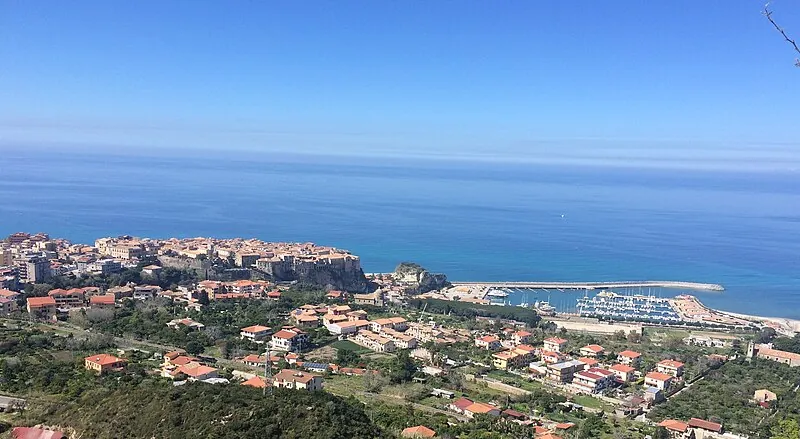
Calabria is the toe of Italy's boot — the long, thin southern region that juts into the Ionian and Tyrrhenian Seas before the straits of Messina separate it from Sicily. It is the poorest region of mainland Italy, the most emigrated-from in the country's history, and one of the least visited by international tourists. It is also, quietly, one of Italy's most rewarding destinations: spectacular coastline, ancient Greek heritage, mountain villages of extraordinary beauty, and a food culture stubbornly resistant to tourism-driven homogenisation. Calabria is not polished. That is its greatest asset.
Tropea: The Jewel of the Tyrrhenian Coast
Calabria's most famous sight is Tropea — a Baroque town perched on a sandstone cliff above a sea of dazzling turquoise clarity. The Tyrrhenian waters here consistently rank among the clearest in Italy; the beaches below the cliff (accessible by steps) have white-gold sand and a transparency that more famous destinations like the Amalfi Coast can rarely match.
The historic centre of Tropea is a pleasant tangle of Baroque churches and trattorie — small enough to walk in 20 minutes, pleasant enough to wander all day. The Santa Maria dell'Isola church on a rocky promontory just off the coast is one of Calabria's most photographed buildings.
Nearby beaches: Capo Vaticano (stunning cape with multiple coves, 15km south), Pizzo (cliff-top town famous for its tartufo ice cream and a dramatic sea-cave chapel).
Scilla: The Town of the Monster
Scilla (ancient Scylla, the mythological sea monster) guards the northern entrance to the Strait of Messina. Its Chianalea district — a tiny fishing village where houses line a narrow channel barely wider than a rowing boat, with fishing boats moored directly below residents' windows — is one of the most beautiful and unusual streetscapes in Italy. Largely undiscovered by mass tourism, it offers an experience of authentic Calabrian fishing life that is rapidly disappearing from the rest of coastal Italy.
The Ancient Greeks: Magna Graecia
Before Rome, before the Normans, before the Spanish — Calabria was one of the heartlands of Magna Graecia, the network of Greek colonies that spread across southern Italy and Sicily from the 8th century BCE. The Greek city-state of Kroton (modern Crotone) was one of the most powerful in the ancient world — birthplace of Pythagoras (who ran his philosophical school here), home of the greatest Olympic athletes of antiquity, and famed for its medical school.
The most dramatic surviving monument of Calabria's Greek past is the Tempio di Hera Lacinia at Capo Colonna — a single Doric column surviving from what was once one of the most sacred temples in Magna Graecia, standing on a promontory above the Ionian Sea with a view of the same coastline the Greek ships once used to navigate. Profoundly atmospheric.
The Aspromonte: The Wild Interior
The Parco Nazionale dell'Aspromonte occupies the extreme southern tip of the Italian mainland — a dramatic granite massif rising to 1,955m, with forest cover that hides ancient villages, waterfalls, and in winter, surprising amounts of snow. The mountain's reputation (the 'Ndrangheta organised crime organisation has historically operated in parts of this territory) has kept it off the tourist map — which means those who visit encounter mountain villages that feel genuinely unchanged by tourism.
The village of Civita is particularly remarkable — a community of Albanian-Calabrians (Arbëreshë) who have maintained their language, Orthodox Christian faith, and distinct cultural identity since fleeing Ottoman expansion in the 15th century. One of southern Europe's most extraordinary cultural survivals.
The Calabrian Table
Calabrian food is among Italy's most distinctive — shaped by poverty, climate, and the same multicultural heritage that defines its history:
- 'Nduja: The famous spreadable, fiery pork salami — a paste of cured pork fat and Calabrian chilli (peperoncino) that has conquered food markets worldwide. Its true home is the village of Spilinga, where it is made to recipes passed within families for generations.
- Tropea onion: The sweet red onion of Tropea — Cipolla Rossa di Tropea, with IGP geographical protection — is genuinely extraordinary: unusually sweet, mild, and rich. Eaten raw in salads, in tuna conserves, made into jam. A vegetable with serious local pride.
- Bergamot: The citrus fruit grown almost exclusively on Calabria's Ionian coast, used to flavour Earl Grey tea and make perfumes, and increasingly being used in Calabrian cuisine and liqueurs
- Pitta 'mpigliata: A Christmas pastry of Byzantine origin, filled with honey, nuts, and dried fruit — connecting Calabria to its Greek and Byzantine past through dessert
Practical Information
- Getting there: Fly to Lamezia Terme (central, near Tropea) or Reggio Calabria (south). Train from Naples (3–4 hours on high-speed Frecciarossa to Reggio Calabria).
- Getting around: Car hire essential — public transport is limited and slow. Roads are generally good on the coast; mountain roads require care.
- Best time: May–June and September–October for coast and mountains. July–August is beach season — hot (35–38°C) and more crowded at Tropea.
- Budget: Calabria is among Italy's best-value regions — accommodation, food, and wine cost significantly less than Tuscany or the Amalfi Coast.
Related: Sicily: History and Volcanic Drama | Sardinia: Italy's Wildest Island