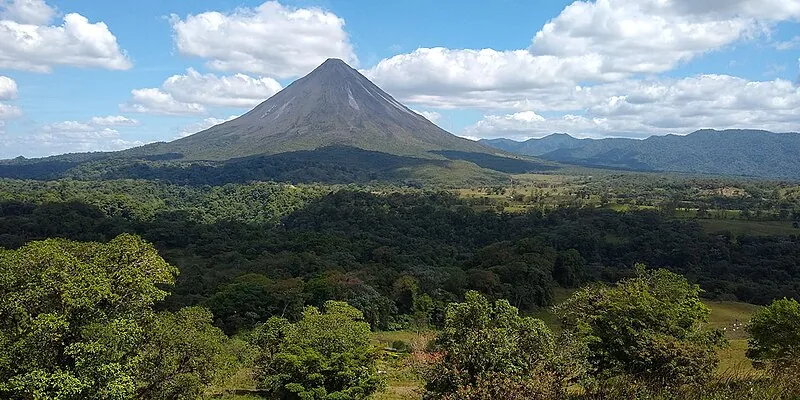
Costa Rica is a country of remarkable statistics: it covers approximately 51,100 km² — roughly the size of West Virginia, or Denmark — yet contains between 4.5% and 5.9% of the world's estimated total biodiversity. Over 900 species of birds (more than all of North America combined), 220 species of reptiles, 35,000 species of insects, and 9,000 species of vascular plants have been documented in a country that abolished its military in 1948 (the constitution prohibits a standing army) and now derives approximately 30% of its GDP from eco-tourism. The concept of pura vida — literally "pure life," used as greeting, farewell, expression of gratitude, and general philosophical statement — is not merely a marketing slogan but a genuinely observable attitude toward life in Costa Rican culture: a pragmatic optimism, a prioritisation of natural wealth over material wealth, a comfort with the organic rhythms of a country where the jungle begins immediately behind most towns and where a scarlet macaw flying over a restaurant terrace is unremarkable. Costa Rica invented sustainable tourism as a concept; experiencing it properly requires leaving the resort zones.
Why Costa Rica Is Biologically Extraordinary
Costa Rica's biodiversity density is explained by its position at the junction of two tectonic plates, three marine currents, and the land bridge between North and South America — a geographic crossroads that makes it simultaneously a transition zone (where species from both continents meet) and a refuge (where ancient species have survived ice ages and extinctions elsewhere). The country also spans eleven distinct ecological zones (from dry tropical forest on the Pacific north coast to cloud forest at 3,400m to Caribbean lowland rainforest) within a 250km width, concentrating extreme habitat diversity into a compact area. The practical result: you can observe in a single trip species that would require crossing three continents in Africa or Asia.
The Essential Destinations
Monteverde Cloud Forest
At 1,400–1,800m in the Tilarán mountain range, the Monteverde Cloud Forest Biological Reserve — founded in 1972 by a group of Quaker settlers from Alabama who relocated to Costa Rica to avoid US military service and to preserve the watershed — protects one of the most species-rich habitats in the Americas. A cloud forest is exactly what the name suggests: forest that is permanently or regularly immersed in cloud, creating a world of moss, bromeliads, orchids, and filtered light where the humidity rarely drops below 100%. The reserve contains:
- Quetzal: The resplendent quetzal (Pharomachrus mocinno) — the bird considered sacred by Mayan and Aztec civilisations, with tail feathers that can reach 1m in length — is most reliably spotted in Monteverde from February to April, when males display during breeding season.
- The hanging bridges: Suspension bridges through the forest canopy (the longest 200m across, 40m above the forest floor) provide a view of the cloud forest from above — a different perspective from ground-level trails, revealing the epiphytic plant communities (bromeliads, orchids, ferns) that live entirely on the branches of host trees without touching the soil.
- Night walks: Cloud forest wildlife is substantially more active at night — guided night walks reveal kinkajous, glass frogs (whose translucent skin makes their organs visible), sleeping birds, tarantulas, and the bizarre variety of insects that make up 80% of the forest's species.
Arenal Volcano and La Fortuna
In the San Carlos lowlands of northern Costa Rica, Arenal Volcano (1,670m) was one of the world's most continuously active volcanoes from its catastrophic 1968 eruption (which killed 87 people and destroyed three villages) until 2010, when activity shifted to a "resting phase." The lack of active lava flows has made the volcano and its national park more accessible; the base town of La Fortuna is now the busiest adventure tourism hub in Costa Rica:
- Hot springs: The geothermal activity that powered the volcano still heats the underground water of the La Fortuna area — the Tabacón hot springs (a series of river-fed pools at 30–40°C in a jungle setting) are the most famous, but smaller local pools are cheaper and less crowded.
- Mistico Hanging Bridges Park: Eight suspension bridges and 16 conventional bridges through primary and secondary forest on the volcano's slopes — well-maintained trails with excellent wildlife spotting (howler monkeys, white-faced capuchins, toucans, and occasionally jaguars).
- Río Fortuna waterfall: A 70m waterfall in the forest 5km from town — the hike down (and back up) is steep enough to be sweaty but accessible for most fitness levels, and the swimming hole at the base is genuinely refreshing.
Manuel Antonio: Biodiversity and Beach Combined
Manuel Antonio National Park — the most visited national park in Costa Rica, on the central Pacific coast — combines white sand beaches with primary forest where wildlife density is extraordinarily high. The park is small (5km² of land) but the concentration of accessible wildlife — three-toed sloths sleeping in the canopy 5m from the path, white-faced capuchin monkeys that have learned to open tourist backpacks, scarlet macaws nesting in coconut palms, ctenosaur iguanas sunbathing on the beach — makes it one of the best places in the world for first-contact tropical wildlife experience. The beaches (Playa Manuel Antonio, Playa Biesanz) are also genuinely beautiful, with calm water protected by the headlands.
Wildlife of Costa Rica: What to Expect
- Sloths: Both two-toed and three-toed sloths are common throughout Costa Rica's forested areas. Three-toed sloths are diurnal (active in daylight, sleeping in visible spots in cecropia trees); two-toed sloths are nocturnal and harder to spot. The Sloth Sanctuary in Cahuita (Caribbean coast) operates a rehabilitation programme and provides close observation access.
- Sea turtles: Four species nest on Costa Rica's beaches — the most spectacular is the leatherback (Dermochelys coriacea, the world's largest reptile at up to 900kg) on the Caribbean coast at Tortuguero (March–July) and Playa Grande on the Pacific (October–March). Turtle nesting tours run at night and are tightly regulated to minimise disturbance.
- Poison dart frogs: Costa Rica's rainforests contain multiple species of dendrobatid (poison dart) frogs — the bright aposematic colouration (blue, red, orange, yellow) advertises to predators that they are toxic. The blue jean frog (Oophaga pumilio), found in the Caribbean lowlands, is among the most vibrantly coloured of all amphibians.
- Scarlet macaws: Once hunted to near-extinction, scarlet macaws have recovered dramatically under Costa Rica's wildlife protection laws — they are now common in the Carara Biological Reserve (Pacific coast), the Osa Peninsula, and around Quepos/Manuel Antonio.
The Osa Peninsula: Wilderness at Its Most Intense
In the far southwest, the Osa Peninsula — which National Geographic called "the most biologically intense place on Earth" — contains Corcovado National Park: 424 km² of primary rainforest with the highest density of jaguars, tapirs, giant anteaters, and harpy eagles in Central America. Access requires a boat or 4WD vehicle on rough roads; accommodation ranges from basic ranger-station camping to the luxury eco-lodges (Lapa Rios, Bosque del Cabo) that have pioneered the model of luxury eco-tourism in Costa Rica. Corcovado requires guided entry (mandated by the park since 2014, after two tourist deaths) and should be planned well in advance.
Practical Information
- Getting there: Juan Santamaría International Airport (SJO), San José. Direct flights from all US hubs (3–6 hours), and from European hubs via Miami or Houston. A domestic flight network (SANSA, Green Airways) connects San José to Liberia, Quepos, Palmar Sur, and Drake Bay — essential for accessing remote areas efficiently.
- Getting around: 4WD rental is strongly recommended for any off-main-highway travel (many roads are unpaved and flood in the rainy season). Public buses connect major destinations cheaply. Shared shuttle vans (running set routes between tourism hubs) are the traveller compromise: more comfortable than buses, cheaper than private transfers.
- Rainy vs dry season: December–April is the dry season on the Pacific coast; May–November brings afternoon rain (the "green season" — forests are lushest, wildlife most active, prices lowest, crowds thinnest). The Caribbean coast has an inverse pattern: its dry season is February–March and September–October.
- Budget: Costa Rica is the most expensive destination in Central America — comparable to southern Europe in mid-range. Budget travellers: $60–$80/day. Mid-range (comfortable ecolodge, restaurant meals): $120–$200/day. Luxury eco-lodges run $300–$800+/night but include meals and activities.
Related: Panama: The Canal, the Cloud Forest, and the San Blas Islands | Colombia: Medellín, Cartagena, and the Coffee Region