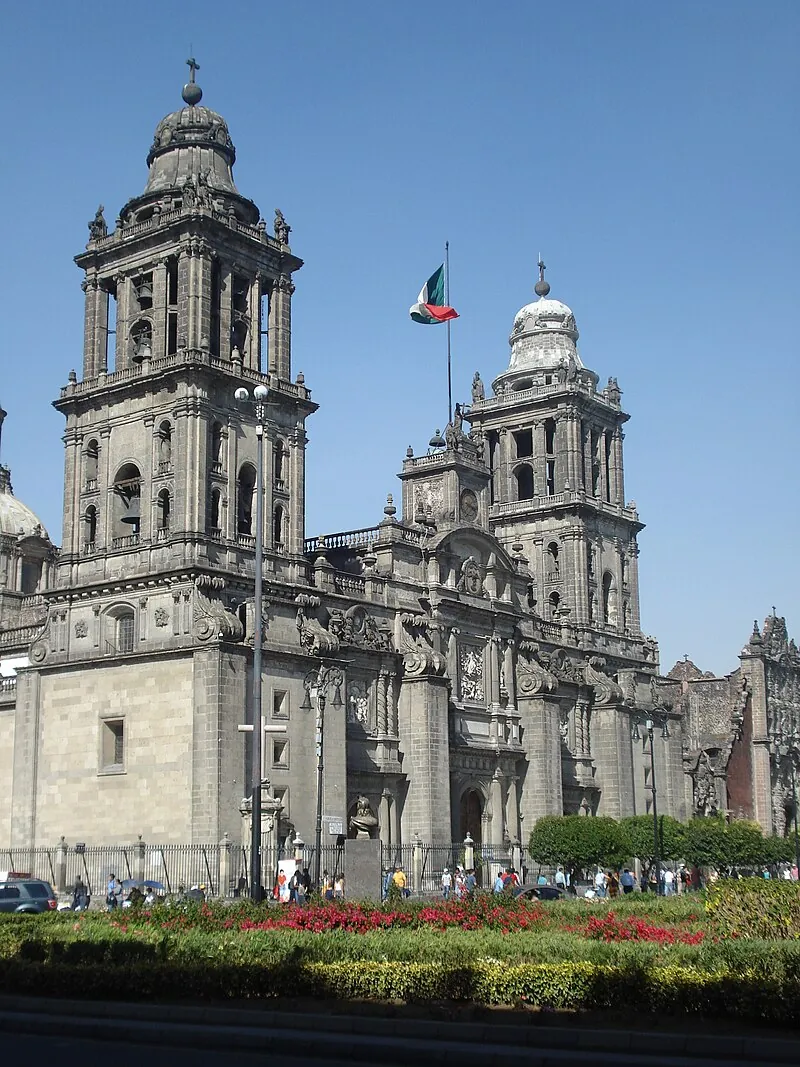
Mexico City, known as CDMX to its residents, is one of the great cities of the world and, for many travellers, a transformative discovery. With a population of around 22 million in the greater metropolitan area, it is the largest city in North America and home to more museums than any other city on Earth (over 150 by most counts), a street food culture of extraordinary depth and diversity, some of Latin America's finest contemporary architecture, and a layer of Aztec, colonial, and modern history compressed into a single astonishing urban environment. It also sits at 2,240 metres above sea level, which means newcomers should plan an easy first afternoon to acclimatise before attempting long walks or vigorous activity.
The Historic Centre: Zócalo and Templo Mayor
The Zócalo (officially the Plaza de la Constitución) is Mexico City's main square and, at 46,000 square metres, the third-largest city square in the world after Tiananmen Square and Ratu Grounds in Suva. It is the symbolic heart of the city and the nation, flanked by the National Palace, the Metropolitan Cathedral, and the federal government offices. The Mexican flag at the square's centre is changed ceremonially each morning.
The Metropolitan Cathedral (Catedral Metropolitana) was constructed over 250 years, beginning in 1573, with the result that its interior is an extraordinary accumulation of architectural styles from early Renaissance to Baroque to Neoclassical. The building is visibly sinking into the soft lakebed soils that the entire historic centre rests on: internal steel cables hold the structure in tension, and the floor inside is noticeably undulating. Entry is free; guided tours in English are available for around MXN 150–200 per person.
Behind the Cathedral, the Templo Mayor is one of the most remarkable archaeological sites in the Americas. When construction workers were laying a cable in 1978, they accidentally uncovered a 3.25-metre stone disc depicting the dismembered moon goddess Coyolxauhqui. Excavations over the following years revealed the main pyramid of Tenochtitlan, the Aztec capital that became Mexico City, built directly below the colonial streets. The museum at the site (MXN 90 entry) houses thousands of artefacts including fearsome Aztec skulls, ritual objects, and the original Coyolxauhqui disc. The excavation continues: archaeologists are still uncovering new structures each year.
Chapultepec Park and the Museum of Anthropology
Bosque de Chapultepec is the largest urban park in Latin America at 686 hectares, roughly three times the size of New York's Central Park. It houses two lakes, a zoo (free entry), an amusement park, and no fewer than nine museums. The park is also a social institution: on weekends it fills with families, cyclists, joggers, and couples, particularly around the lakeside areas where pedal boats can be rented for MXN 80–100 per hour.
The Museo Nacional de Antropología (National Museum of Anthropology) is unambiguously one of the finest museums in the world. Opened in 1964 and designed by Pedro Ramírez Vázquez with its enormous umbrella-supported roof over the central courtyard, it holds the greatest collection of pre-Columbian artefacts anywhere. The Mexica (Aztec) room anchors the ground floor and contains two objects of singular power: the Aztec Sun Stone (often incorrectly called the "Aztec Calendar"), a 3.6-metre basalt disc weighing 24 tonnes depicting the Aztec cosmological system, and the monolithic statue of Tlaltecuhtli, the earth goddess, only excavated in 2006 and displayed in full polychrome colour. The upper floor covers indigenous cultures from across Mexico with equal depth. Entry costs MXN 90 (free for children, students, and teachers with ID); a full visit takes 3–4 hours at minimum.
Also in Chapultepec: the Castillo de Chapultepec, a 19th-century hilltop castle that served as the residence of Emperor Maximilian I during the brief French intervention and later as the presidential residence until 1939. The views from its terrace over the city are outstanding, and the interior preserves the original Art Nouveau decor of Maximilian and Empress Carlota. Entry MXN 90.
Roma and Condesa: The Creative Core
The Roma and Condesa neighbourhoods, adjacent and blending into one another in the city's west, are the epicentre of Mexico City's contemporary restaurant, bar, and cultural scene. The area was devastated by the 1985 earthquake, which levelled thousands of buildings, and its subsequent rebuilding attracted young architects, artists, and chefs who shaped its current identity. Roma Norte and Condesa's Art Deco apartment buildings, tree-lined streets (particularly Avenida Ámsterdam in Condesa, which follows the oval of a former horse-racing track), and density of quality restaurants make this the area most international visitors choose to stay in.
Restaurants worth singling out: Contramar (Roma Norte), open since 1998 and still serving some of the best seafood in the city (grilled tuna tostadas, red and green tuna, whole fish with salsa); expect a wait at lunch even with a reservation. Pujol, Enrique Olvera's flagship, has held its place in the World's 50 Best Restaurants list for over a decade; the tasting menu costs around MXN 3,500–4,000 per person (approximately $175–200). For a more accessible experience, the Mercado de Medellín in Roma Sur offers fresh produce, tacos, tortas, and juices in a covered market setting for MXN 30–80 per dish.
Coyoacán: Frida Kahlo and the Intellectual South
Coyoacán is a borough about 10 kilometres south of the historic centre, connected by Metro Line 3 (to Coyoacán or Viveros station). It has a distinct village character despite being entirely surrounded by the urban fabric, with cobbled streets, a lively central plaza (Jardín del Centenario), and a strong intellectual and artistic history: Leon Trotsky lived and was assassinated here in 1940; Diego Rivera and Frida Kahlo spent much of their lives here.
The Museo Frida Kahlo (the Blue House, or La Casa Azul) is the most visited museum in Coyoacán and one of the most popular in Mexico City. It preserves Kahlo's home exactly as it was at her death in 1954, with her studio, personal belongings, and a significant number of her paintings in context. Entry costs MXN 270 (approximately $14). Advance booking is essential; tickets often sell out 1–2 weeks ahead on the official website. The Museo Casa de León Trotsky, a short walk away, is less visited but deeply compelling: Trotsky's study still bears the marks of the first, failed assassination attempt in May 1940, and the garden contains his tomb. Entry MXN 55.
The Coyoacán weekend market around the Jardín Hidalgo fills with street food vendors (blue corn tlayudas, elotes, churros, artisan crafts) and is one of the most pleasant ways to spend a Sunday morning in the city.
UNAM: The World's Largest University Campus
The National Autonomous University of Mexico (UNAM) campus in southern Mexico City is a UNESCO World Heritage Site and the largest university campus in the world by land area at 730 hectares. The campus was designed in the early 1950s by a collective of Mexico's greatest architects and artists, integrating Diego Rivera's famous mosaic mural on the library exterior (depicting the history of Mexican knowledge) with José Chávez Morado's mosaic on the Rectory Tower. The Estadio Olímpico Universitario, designed to resemble a volcanic crater with Rivera's mural bas-relief on its exterior, hosted the 1968 Olympics athletics events. Entry to the campus is free and open to visitors; the library mosaics alone justify the trip.
Food: Tacos and Beyond
Mexico City's food culture runs from the extraordinary to the transcendent. The taco al pastor, arguably the city's signature street food, is pork marinated in dried chillies and spices, cooked on a vertical spit (trompo) adapted from Lebanese shawarma by Lebanese immigrants in the mid-20th century, and served on a small corn tortilla with pineapple, onion, and cilantro. El Huequito, founded in 1959 in the historic centre and claiming to be the birthplace of the taco al pastor in its current form, still serves them from MXN 18–25 each from a tiny street-facing opening.
Other essential Mexico City foods: pozole (a hearty hominy corn soup, most commonly red or green, with pork, radish, and lime, MXN 80–150 at a traditional restaurant); tamales (corn masa steamed in a corn husk, sold from enormous pots by street vendors each morning, MXN 15–25 each); tlayudas (large crisp tortillas with beans, cheese, and meat, a Oaxacan specialty but widely available); and mezcal (smoky agave spirit), which has a dedicated bar scene in Roma Norte where a quality pour costs MXN 80–150 per glass.
Getting Around: Metro and Safety
The Metro del Sistema de Transporte Colectivo is the second-largest metro system in the Americas after New York City's, covering 12 lines and 195 stations. A single journey costs MXN 5 (approximately $0.25), making it the cheapest metro in any major world city. It is also frequently crowded, particularly Lines 1, 2, and 3 during peak hours. During rush hour (07:30–09:30 and 18:00–20:00), the front carriages of each train are reserved for women and children only. Pickpocketing occurs in crowded carriages; keep bags in front and phones pocketed.
For convenience, safety, and comfort, Uber is strongly recommended over street taxis in Mexico City. Street taxis are unmetered and, more seriously, have historically been used for "express kidnappings" where passengers are driven to ATMs and forced to withdraw cash. This crime has decreased significantly in recent years but Uber's tracked, registered service eliminates the risk entirely. A typical city crossing by Uber costs MXN 80–150 (approximately $4–7).
The Roma, Condesa, Polanco, and Coyoacán neighbourhoods are very safe by the standards of any major city and can be explored on foot without concern day or night. The historic centre is safe during the day and early evening. Areas to avoid include Tepito (north of the historic centre, a major black market area), Doctores, and parts of Iztapalapa. The US State Department rates Mexico City at Level 2 (Exercise Increased Caution) rather than the higher levels assigned to some other Mexican states.
Altitude and Acclimatisation
At 2,240 metres above sea level, Mexico City is high enough to cause mild altitude sickness in some visitors. Common symptoms include headache, fatigue, and slight breathlessness, typically lasting 12–24 hours. Arriving by afternoon, drinking extra water, avoiding alcohol on the first night, and taking it easy on arrival day eliminates most symptoms. Ibuprofen or paracetamol handles any headache. The altitude has one useful side effect: temperatures are mild year-round (18–24°C in the daytime), far more comfortable than Mexico's coastal cities.
Related: Oaxaca Travel Guide: Markets, Mole, and Mezcal | Colombia Travel Guide: Cartagena, Medellín, and the Coffee Region