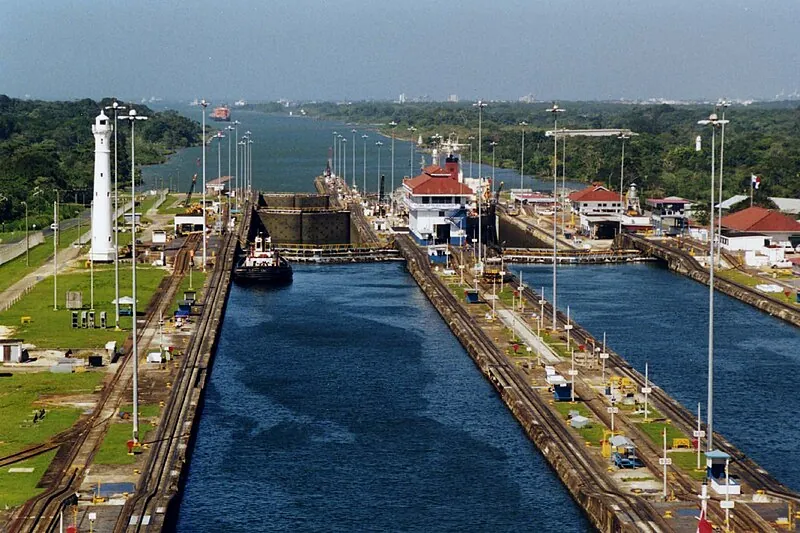
Panama punches well above its weight as a travel destination. In a country slightly smaller than South Carolina, you can watch container ships pass through one of the world's greatest engineering projects, eat ceviche in a UNESCO-listed colonial neighbourhood, sleep in an overwater bungalow on the Caribbean, hike cloud forest in search of the resplendent quetzal, and spend a week among 365 pristine islands governed by indigenous communities. It is also among the easiest Central American countries to visit: the currency is the US dollar (locally called the Balboa), most Western passports require no visa, and Panama City has a modern, well-connected international airport.
Panama City: The Canal and Casco Viejo
The Panama Canal
The Panama Canal stretches 77 kilometres across the isthmus of Panama, linking the Atlantic and Pacific oceans and saving ships from the 14,000-kilometre detour around Cape Horn. Completed in 1914 and expanded with a new set of locks in 2016, it handles roughly $270 billion worth of goods annually and remains a jaw-dropping piece of infrastructure.
The Miraflores Locks visitor centre, about 10 kilometres from downtown Panama City, is the best place to watch ships being raised and lowered through the locks. The centre is open daily from 09:00 to 17:00, and entry costs $20 for adults, $10 for children. The best window to catch ships transiting is 09:00 to 11:00. The four-storey visitor centre includes a museum with a detailed history of the canal's construction, including the extraordinary human cost: over 27,500 workers died during the American construction period, primarily from yellow fever and malaria, before William Gorgas's mosquito control programme turned the tide.
For a full transit of the canal by boat, operators like Panama Marine Adventures offer partial or full transit tours from $165 per person. These take 8–10 hours and are popular during cruise season (October to April).
Casco Viejo
Casco Viejo (also called San Felipe) is Panama City's colonial old town, designated a UNESCO World Heritage Site in 1997. Built on a peninsula after pirates destroyed the original city in 1671, it has been undergoing steady renovation since the 2000s and is now a compelling mix of restored colonial mansions, crumbling ruins, boutique hotels, rooftop bars, and independent restaurants.
The Plaza de la Independencia (or Plaza Mayor) is the central square, flanked by the Metropolitan Cathedral and the Canal Museum. The Ruins of the Old Panama Cathedral Tower, just outside the historic quarter, are remnants of the original city sacked by Henry Morgan. Rooftop bars like Tantalo Hotel's bar offer views across the bay to the modern skyline. Dinner in Casco Viejo at a good restaurant runs $30–50 per person with drinks.
Bocas del Toro: Caribbean Island Life
The Bocas del Toro archipelago on Panama's Caribbean coast consists of nine main islands and dozens of smaller ones, all connected by water taxis. The provincial capital, Bocas Town, sits on Isla Colón and has the most accommodation, restaurants, and nightlife. Starfish Beach, on the far side of Isla Colón, is a postcard vision of pale water and red starfish (please look, don't touch: the starfish are living animals and handling them stresses and can kill them).
Red Frog Beach on Isla Bastimentos is Bocas del Toro's most striking beach, named for the red poison dart frogs (Oophaga pumilio) that live in the surrounding jungle. The beach is reached by a short walk through the forest. Snorkelling and diving in the archipelago is excellent: Almirante Bay has healthy coral, and Crawl Cay and Hospital Point are two of the best dive sites. A two-tank dive costs around $70–85 with a local operator.
Accommodation in Bocas ranges from $15–25 per night in backpacker hostels to $80–150 for a mid-range hotel. Several overwater bungalow properties operate in the archipelago, ranging from basic to genuinely luxurious. Getting to Bocas del Toro from Panama City requires either a 1-hour flight with Air Panama (from around $120 each way) or a bus to Almirante followed by a water taxi (around $2–3), which takes roughly 8 hours total.
Boquete: Coffee, Cloud Forest, and the Quetzal Trail
Boquete is a small mountain town in the Chiriquí highlands, about 470 kilometres west of Panama City and a 6-hour bus journey from the capital. Sitting at 1,200 metres elevation, it is noticeably cooler than the coast, which makes it a popular escape for both travellers and the large expat community that has settled here over the past two decades.
The surrounding mountains produce some of Central America's best coffee. The Boquete Coffee Tour at farms like Café Ruiz (one of Panama's oldest family-owned producers) costs around $25–30 per person and includes a walk through the plantation, a look at processing, and cupping. Panama's Geisha variety, grown in the highlands above Boquete, regularly fetches over $1,000 per kilogram at auction and is considered by many roasters the most complex coffee in the world.
The Quetzal Trail, a roughly 14-kilometre trail through La Amistad International Park, is one of Central America's best birding hikes. The resplendent quetzal, with its iridescent green plumage and metre-long tail feathers, is reliably spotted here between January and April during breeding season. A guided hike with a local operator costs $40–60 per person.
San Blas Islands: Panama's Most Remote Destination
The San Blas archipelago, officially known as Guna Yala, consists of 365 islands off Panama's Caribbean coast, of which about 36 are inhabited. The islands are governed autonomously by the Guna indigenous people, who have maintained political control over their territory since a 1925 uprising against Panamanian authority. Visitors pay a $20 entry fee and an additional community fee of around $10–15 per day. Photography of local residents requires permission and a small payment.
The islands are reached by 4x4 vehicle from Panama City over a rough jungle road (about 4 hours) followed by a short boat transfer, or by light aircraft (around $70–100 each way with Aeroperlas). Accommodation is in basic palmwood-and-thatch cabanas directly over the water, typically ranging from $50–120 per person including three meals. The San Blas experience is raw, beautiful, and culturally rich: the Guna maintain traditional mola textile crafts, elaborate ceremonies, and a community-first approach to tourism that is genuinely different from anything you will encounter in Panama City.
Practical Information
Currency: Panama uses the US dollar (called the Balboa domestically, with identical coins). Credit cards are accepted at most hotels and larger restaurants. ATMs are widely available in Panama City and Bocas del Toro; less so in San Blas and on smaller islands.
Visa: Citizens of the US, UK, EU, Canada, Australia, and most Western nations do not require a visa. You will need a return ticket and evidence of onward travel. Entry is permitted for 180 days.
Budget: Panama City is comparable in cost to a mid-range Latin American capital. Budget travellers can manage on $60–70 per day. A comfortable mid-range experience (decent hotel, restaurant meals, activities) costs $100–150 per day. Bocas del Toro and Boquete are cheaper; San Blas is moderately priced once you factor in the all-inclusive nature of most cabana packages.
Getting around: Domestic flights with Air Panama connect Panama City to Bocas del Toro, David (for Boquete), and San Blas. Buses are cheap and reliable on the main Interamerican Highway. Uber operates in Panama City and is strongly preferred over street taxis, which lack meters.
Related: Costa Rica Travel Guide: Rainforest, Wildlife, and Beaches | Colombia Travel Guide: Cartagena, Medellín, and the Coffee Region