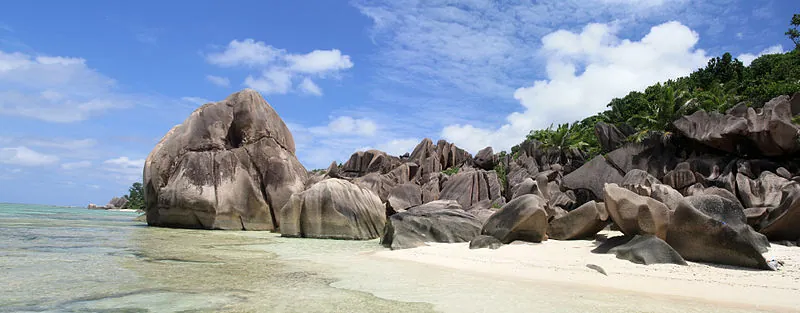
There are beautiful beaches everywhere in the Indian Ocean. There are clear waters, palm trees, and sun-bleached sand from the Maldives to Mauritius. But the Seychelles has something that nowhere else does: the granittic outer islands — ancient geological formations of sculpted pink granite rising from water of impossible blue-green clarity, draped in tropical forest, and fringed by beaches where the sand is luminous white and the granite boulders form natural sculptures beside which you can swim, read, and simply exist in a state of straightforward happiness. The Seychelles is not a destination that requires effort to appreciate. It requires only presence.
The Islands: Where to Go
Mahé: The Hub
The largest island (27km long) and location of the capital Victoria — the world's smallest capital city — and the international airport. Most visitors arrive here but quickly move on. Worth seeing: the clock tower (a miniature of London's Big Ben), the Sir Selwyn Selwyn-Clarke Market (fresh fish, tropical fruit, spices), and the beaches of Anse Intendance (dramatic surf, not calm) and Petite Anse.
Praslin: The Coconut Forest
The second-largest island, home to the Vallée de Mai — a UNESCO World Heritage primeval palm forest containing the coco de mer, a palm producing the world's largest seed (up to 25kg). The coco de mer was long believed to grow on an underwater tree in the depths of the Indian Ocean and was considered magical when found washed up on distant shores. The forest, which the Seychellois believe to be the original Garden of Eden, contains several bird species found nowhere else including the black parrot.
Praslin's Anse Lazio beach is consistently ranked among the world's finest — a semicircle of granite, soft sand, and snorkelling-perfect water. The restaurant at the northern end serves excellent grilled fish.
La Digue: The Timeless Island
La Digue is reached by ferry from Praslin (15 minutes) and exists largely without motorised vehicles — transport is by bicycle or ox cart. The pace is deliberately, perfectly slow. Anse Source d'Argent — frequently cited as the world's most photographed beach — is a series of coves between sculpted granite boulders, the water shallow and warm and so clear it barely seems like water. Arrive early (before 9am) to have it to yourself.
Marine Life: The Underwater Seychelles
The Seychelles sits at the heart of one of the Indian Ocean's most productive marine zones. The outer coral atolls — particularly Aldabra Atoll, the world's largest raised coral atoll and a UNESCO World Heritage site — support biodiversity that rivals the Galápagos. Aldabra is home to 150,000 Aldabra giant tortoises (the world's largest wild tortoise population), frigatebirds, boobies, and marine life of extraordinary richness.
More accessible diving and snorkelling: coral reefs around Praslin and La Digue, whale shark aggregations (seasonally), sea turtles nesting on several beaches, and manta ray cleaning stations. The Aldabra Atoll requires a permit and is only accessible by liveaboard dive vessel — an expedition experience of the first order.
Seychellois Cuisine
Seychellois food reflects the archipelago's history as a crossroads of African, Asian, French, and Indian Ocean cultures:
- Grilled red snapper or job fish with coconut curry — the definitive Seychellois meal
- Ladob: plantain or breadfruit cooked in coconut milk with vanilla and nutmeg — a comfort dessert
- Shark chutney: smoked shark blended with bilimbi (sour fruit) and chilli — a breakfast staple
- Cari: Creole curries of fish, octopus, or chicken in coconut and spice
Practical Information
- Getting there: Mahé International Airport has direct flights from Europe (Emirates via Dubai, Air Seychelles, British Airways from London) and connections from the Gulf, East Africa, and Asia
- Best time: April–May and October–November are the calmest months (transition seasons between trade winds). December–February has the northwest monsoon — less reliable weather on some islands. June–September brings the cooler southeast trade winds — rough on the west coasts, perfect on the east.
- Budget: One of the world's most expensive destinations. Mid-range guesthouses $150–300/night; luxury resorts $500–3,000+. Self-catering accommodation is possible and brings costs down significantly.
- For couples/honeymoon: La Digue (bicycle to Anse Source d'Argent), private island resorts (North Island, Fregate, Denis Island), sunset dhow cruise
- For nature: Vallée de Mai (Praslin), Aldabra expedition, sea turtle nesting at Cousine Island
Related: Dominican Republic: Beyond the All-Inclusive | Egypt's Red Sea Beaches