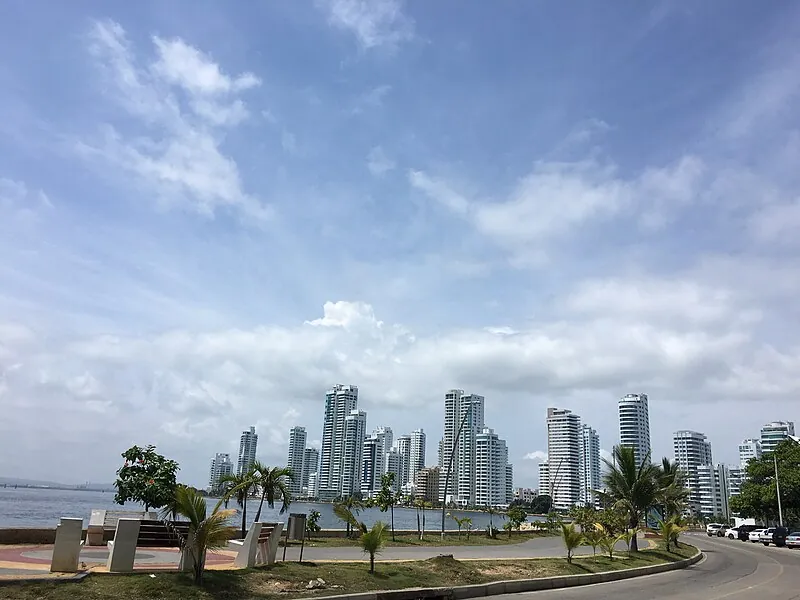
South America's coastline stretches over 28,000km from Colombia's Caribbean shore to Argentina's Patagonian cliffs — a range that encompasses Caribbean islands, tropical Atlantic surf, the driest desert on Earth, Pacific jungle coves, and everything in between. Unlike the Caribbean proper (where most beaches are resort-structured and internationally homogenised), South America's beaches retain the character of the countries behind them: the cumbia and ceviche of Colombia, the baile funk and caipirinha of Brazil, the raw ceviche and desert surrealism of Peru. The beach experiences vary not just in scenery but in culture — and that distinctiveness is what makes South American coastal travel some of the world's most rewarding.
Colombia: Caribbean Coast and the Pacific Jewel
Cartagena and the Rosario Islands
Cartagena de Indias is not primarily a beach destination — it is one of the Americas' most beautiful colonial cities, its 16th-century walled historic district (Ciudad Amurallada, UNESCO-listed) a maze of colourful houses, bougainvillea-draped balconies, and churches built with slave labour on the trade routes of the Spanish Empire. But the beach experience is directly attached: the Islas del Rosario (45 minutes by boat from Cartagena) are a protected archipelago of coral reefs and clear Caribbean water, reached by lancha in the morning for snorkelling and swimming and returned from by sunset. The combination of colonial city history and day-trip Caribbean paradise is unique in the Americas.
The Tayrona National Park (5 hours east of Cartagena along the Caribbean coast) offers something rarer: beaches reached only on foot through tropical forest (30–90 minute hikes), where no motorised vehicles operate and the jungle descends directly to enormous boulders and Caribbean surf. Cabo San Juan within the park is one of South America's most beautiful beach settings — emerald water, dramatic rocks, coconut palms, and the knowledge that the distance walked to reach it has filtered the crowd significantly.
Nuquí and Colombia's Pacific Coast
Colombia's Pacific coast — accessible only by small plane from Medellín — is one of the Americas' least visited and most extraordinary coastal environments. Nuquí and the surrounding bays offer world-class surf (consistent Pacific swell, few surfers), humpback whale watching (July–October, one of the Pacific's most reliable sightings), and a landscape of primary rainforest meeting black volcanic sand beaches under almost constant tropical rain. This is not comfort tourism — the lodges are simple, the food is local (Pacific ceviche, patacones, fresh fish), and the access involves small planes over jungle. For those who find it, it is transformative.
Brazil: The Continent's Beach Culture
Brazil has the world's most beach-obsessed culture and a coastline of 7,400km that provides ample material for the obsession. The range is too vast for a brief survey; the essential stops:
Fernando de Noronha
Fernando de Noronha — a volcanic archipelago 354km offshore in the Atlantic, with strictly controlled visitor numbers, no private vehicles, and some of the clearest water in the South Atlantic — is Brazil's most celebrated beach destination and, by the informed consensus of beach enthusiasts who have visited both, one of the world's finest. Baía do Sancho (consistently ranked among the world's best beaches) is reached by a short descent through a cliff crack; the water's colour — a startling deep turquoise of Caribbean clarity — is the result of minimal river runoff and exceptional depth. Spinner dolphins ride the bow wave of every boat in the archipelago. Expensive (entry fees, limited accommodation), worth every cost.
Florianópolis
Florianópolis — "Floripa" — is a Santa Catarina island that has become Brazil's surfing capital and one of its most liveable cities. Its 42 beaches range from the surf breaks of Praia Mole and Joaquina (consistent surf, large Brazilian surfing communities) to the calm lagoon of Lagoa da Conceição (windsurfing, kite surfing, sunset boat trips) to the remote wild beaches of the island's south. The infrastructure is Brazilian — chaotic, vivid, excellent food — but the natural setting is exceptional.
The Bahian Coast
The northeast Brazilian state of Bahia — the cultural heart of Afro-Brazilian culture — has a coastline of extraordinary quality that stretches 932km. Porto Seguro, Arraial d'Ajuda, and Trancoso offer a range from the party beach of Arraial to the cobblestoned quadrado (village square) of Trancoso — a former 1970s hippie settlement that has been discovered by Brazilian and international elites but retains its low-rise, foot-traffic-only character. Morro de São Paulo (accessible only by boat, no cars on the island) offers Caribbean-coloured water and a low-key tropical island experience 90 minutes from Salvador.
Peru: Desert Coast, Surf Towns, and the Paracas Reserve
Peru's Pacific coast is one of the world's most unexpected and dramatic beach environments: the Humboldt Current brings cold, nutrient-rich water from Antarctica northward along the entire coast, creating an almost perpetual coastal fog (garúa) and a marine ecosystem of extraordinary productivity — but also a coast that is dryer than the Sahara Desert immediately inland, producing the surreal juxtaposition of sand dunes meeting the Pacific.
Paracas and the Ballestas Islands
The Paracas National Reserve (4 hours south of Lima) protects a peninsula of extraordinary desert-meets-ocean scenery — red sand cliffs, wild flamingos in the bay, vast sea lion colonies, and water of cold clarity. The Islas Ballestas (accessible by morning boat, no landing permitted) are Peru's "poor man's Galápagos" — dense colonies of Humboldt penguins, sea lions, pelicans, boobies, and the enormous guanay cormorant, feeding on the upwelling of the Humboldt Current. No snorkelling, no beach: pure wildlife spectacle at close range.
Máncora: Peru's Surfing Escape
Máncora, 17 hours north of Lima near the Ecuadorian border (where the Humboldt Current weakens and water temperature rises), is Peru's surf and backpacker beach hub: warm water (finally), consistent beach break surf, ceviche and cerveza, and a beach-town atmosphere that has been genuinely international for a decade. The point break at Lobitos (an hour south) is one of the finest left-handers on the Pacific coast, uncrowded by global standards.
Lima's Food-and-Coast Combination
Lima itself — while not primarily a beach destination — merits inclusion for the combination of its cliff-top position above the Pacific (the Miraflores district's Malecón walkway runs along the clifftop above the surf, with paragliders launching from the park in the afternoon) and its status as South America's food capital. The ceviche of Lima — raw fish cured in tiger's milk (leche de tigre, a citrus-cured fish marinade), chilli, and onion — is the greatest expression of a dish that exists everywhere on this coast but nowhere better than here.
Practical Information
- Best time (Colombia): December–April for the Caribbean coast (dry season); July–October for the Pacific (whale watching). Cartagena is year-round.
- Best time (Brazil): Varies enormously by region. November–March is summer and peak beach season in the south; the northeast (Bahia, Fortaleza) is drier June–January.
- Best time (Peru): December–April for Máncora (dry, warm); Paracas is year-round. Lima's coast is foggy May–November.
- Safety: Research specific areas before visiting — urban safety varies considerably by city and neighbourhood. Beach resort towns and national parks are generally very safe; city arrival and transport deserve more research.
Related: The Dominican Republic: Caribbean Beaches and Beyond | The Seychelles: Indian Ocean Paradise