For most of the 20th century, Uzbekistan was closed to independent travellers: a Soviet republic with strict travel controls, a closed currency, mandatory hotel registration, and a government that discouraged outside scrutiny. The country changed dramatically after the death of President Islam Karimov in September 2016. His successor, President Shavkat Mirziyoyev, liberalised the visa system (e-visas introduced for most Western nationalities in 2018, followed by visa-free access for citizens of more than 90 countries), ended currency controls, and invested heavily in tourism infrastructure including the Afrosiyob high-speed rail line and a cluster of new hotels in Samarkand and Bukhara. Uzbekistan received 6.7 million tourists in 2023, up from 2.7 million in 2018: a 148% increase in five years. The ancient Silk Road cities, dormant as tourist destinations for decades, are now navigable with a smartphone and a moderate budget. What they contain is extraordinary.
Samarkand: The Jewel of the Silk Road
Samarkand is one of the oldest inhabited cities in Central Asia, continuously settled for at least 2,750 years. Under Timur (Tamerlane), the 14th-century Turco-Mongol conqueror who made it the capital of the Timurid Empire, it became the second-largest city in the Islamic world and a centre of architecture, astronomy, and poetry. The monuments Timur commissioned, and those completed by his descendants, constitute one of the most concentrated assemblages of Islamic architectural achievement anywhere on Earth.
The Registan
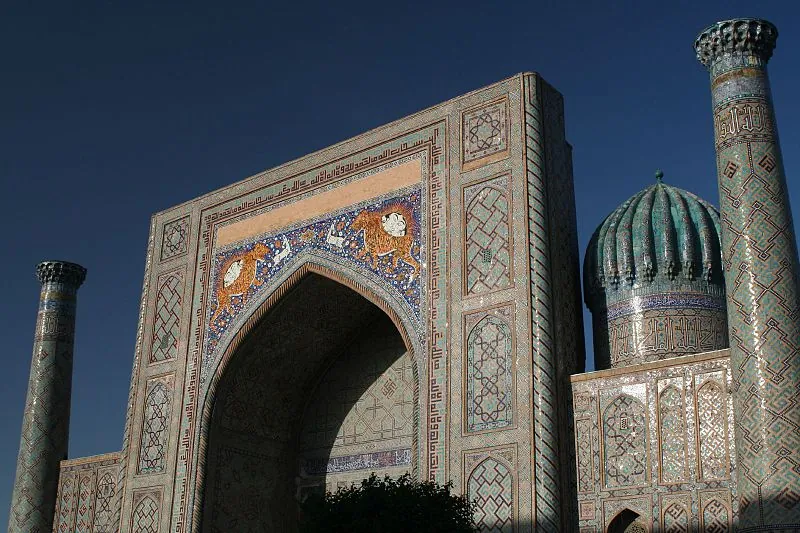
The Registan (meaning "sandy place" in Persian) is a plaza flanked by three madrasas (Islamic religious schools) built between 1420 and 1660 under successive Timurid rulers. The Ulugh Beg Madrasa (1420, built by Timur's grandson and astronomer-king Ulugh Beg), the Sher-Dor Madrasa (1636, notable for its entrance portal decorated with tigers carrying suns on their backs, an unusual motif in Islamic architecture given the religion's traditional prohibition on figurative imagery), and the Tilya-Kori Madrasa (1660, its interior main hall painted entirely in gold leaf, tilla kori meaning "gilded" in Uzbek) enclose a rectangular plaza approximately 100m wide.
At any time of day but especially at the golden hour before sunset, when the turquoise glazed tile facades catch low-angle light and the shadows deepen the geometric patterns, the Registan delivers the visual impact that photographs promise. Entry costs UZS 120,000 (approximately $9.50). Night illumination shows run seasonally; the light and sound show is worth attending if you are visiting in summer. Book through your accommodation.
Gur-e-Amir: The Mausoleum That Inspired the Taj Mahal
The Gur-e-Amir (Persian for "Tomb of the King") was built in 1403 to house the body of Timur himself, who died on campaign in 1405 before completing his planned invasion of Ming China. The building's signature feature is its large ribbed azure dome, 34m high, the prototype for the domed mausoleum form that spread across the Islamic world and eventually produced the Taj Mahal in Agra (designed by architects working in the Timurid-Mughal tradition and completed in 1653). The interior is covered in carved alabaster and dark green onyx, with Timur's tomb (a dark green nephrite slab said to be the largest single piece of nephrite jade in the world) in the lower crypt. The main sarcophagus in the upper chamber is a cenotaph; Timur's body lies directly below it at floor level.
Entry: UZS 60,000 ($4.70). An afternoon walking circuit covering the Gur-e-Amir, the Rukhabad Mausoleum adjacent to it, and the Registan takes approximately three to four hours.
Shah-i-Zinda
Shah-i-Zinda (meaning "The Living King," a reference to a companion of the Prophet Muhammad said to be buried here) is a necropolis of mausoleums built between the 11th and 15th centuries along a narrow processional street ascending a hill northeast of the city centre. The tile work in the individual mausoleums represents the highest achievement of Timurid decorative arts: each tomb is different in its palette and geometric vocabulary, ranging from deep blue and turquoise to turquoise and white to polychrome combinations. Entry: UZS 60,000 ($4.70). Go early (before 9am) or late (after 4pm) to avoid the day-tour groups that make the narrow passage genuinely difficult to navigate at peak hours.
Bukhara: The Better-Preserved City
Bukhara presents a more authentically textured version of historic Uzbekistan than Samarkand, because it has been less aggressively reconstructed. Where the Soviet authorities in Samarkand undertook extensive (and in some cases architecturally controversial) restoration of the main monuments, Bukhara's old city (Lyabi-Hauz area and surrounding mahallas) retains more of its 19th-century urban fabric alongside the major monuments. The pool of Lyabi-Hauz, a rectangular reflecting pool surrounded by mulberry trees and teahouses, is where locals and travellers congregate in the evenings and is one of the more pleasant outdoor sitting spaces in Central Asia.
The Kalon Minaret and Mosque Complex
The Kalon Minaret was built in 1127 under the Kara-Khanid ruler Arslan Khan and stands 47m high, decorated with 14 bands of patterned brickwork, each band different. It is said that when Genghis Khan rode into Bukhara in 1220 (on his way to ordering the massacre of most of the city's population) and his hat fell off as he looked up at the minaret, he paused, replaced the hat, and ordered the minaret spared. Whether true or not, the minaret survived while virtually everything else in the city was destroyed. It was subsequently used as an execution tower (criminals were thrown from the top) and as a lighthouse for caravans approaching across the desert, its fire visible for 30km. Entry to the mosque courtyard is free; the minaret interior is not open to climbers.
The Ark Fortress
The Ark of Bukhara is the city's ancient citadel, in use as a royal palace and administrative centre for at least 2,000 years, with the current structure dating primarily to the 17th century. The ruling emirs of Bukhara lived here until the last emir, Alim Khan, fled before the Red Army in 1920. The interior contains a museum of Bukharan history, royal reception halls, a mosque, and a prison where the British officers Charles Stoddart and Arthur Connolly were held before being publicly beheaded in 1842 (an episode in the 19th-century geopolitical competition between Britain and Russia called the Great Game). Entry: UZS 50,000 ($4).
The Covered Bazaars
Three domed bazaar buildings (tok in Uzbek) have stood at Bukhara's major intersections since the 16th century: Toki-Zargaron (jewellers), Toki-Telpak-Furushon (hat sellers), and Toki-Sarrafon (money changers). They now sell silk, spices, Uzbek knives (pichok, the locally produced folding knives are regional specialties), ceramic plates, and the ikat silk fabric (adras, with complex resist-dyed patterns) for which the Bukhara and Margilan regions are known. Prices are negotiable; the quality at dedicated craft workshops (ustakhona) attached to the bazaars is higher than at tourist stalls.
Khiva: The Open-Air Museum
Khiva is the furthest of the three major Silk Road cities from Tashkent (7 hours by road, or a short domestic flight to Urgench followed by a 30-minute taxi), and the least visited as a result. It is also the best-preserved. The inner walled city, Ichon-Qala, is a UNESCO World Heritage Site and is still partly inhabited by approximately 2,500 residents within walls that have stood since the 10th century. The density of historic monuments within a space roughly 650m by 400m is remarkable: the Juma Mosque (whose interior forest of 213 wooden columns, each carved differently, is the architectural highlight of the city), the Islam Khoja Minaret (1910, the tallest in Khiva at 57m), the Tash-Hauli Palace (19th-century royal harem complex), and the Kunya-Ark citadel all within walking distance of each other.
Entry to Ichon-Qala's interior monuments: a combined ticket (covering all major buildings) costs UZS 150,000 ($11.80). The outer city (Dichan-Kala) is free and worth walking for the mud-brick residential architecture and small neighbourhood mosques. Khiva is a day-trip from Urgench but merits two nights to see it at the atmospheric extremes of early morning and evening.
Getting Between the Cities: The Afrosiyob Train
The Afrosiyob high-speed rail service, operated by Uzbekistan Railways, connects Tashkent with Samarkand and Bukhara at speeds of up to 250km/h. Journey times: Tashkent to Samarkand in 2 hours 10 minutes, Samarkand to Bukhara in a further 1 hour 30 minutes. Tickets cost $10–30 depending on class (economy/business) and booking date. The train departs multiple times daily from Tashkent; book through the Uzbekistan Railways website or through your accommodation, as online booking from outside Uzbekistan can be unreliable and a local agent is sometimes easier.
From Bukhara to Khiva, no direct train service exists; shared taxis (taking 5–7 hours along the desert highway between the Zeravshan Valley and the Khorezm Oasis) cost $15–20 per seat. A domestic flight from Bukhara to Urgench (the airport for Khiva) takes 1 hour and costs $40–80 with Uzbekistan Airways or Qanot Sharq.
Uzbek Food: What to Eat and Where
Uzbek cuisine is built around a small number of dishes prepared with great care and eaten communally:
- Plov: the national dish. Rice cooked with lamb or beef, carrots, onions, garlic, and cumin in a large kazan (cast-iron cauldron) over high heat in cottonseed oil. Regional variations exist: Tashkent plov includes chickpeas and quail eggs; Samarkand plov uses undyed rice and a different layering technique. A proper plov, eaten at a chaykhana (teahouse) where it is cooked fresh in the morning, costs UZS 25,000–40,000 ($2–3.15). Do not confuse it with the evening restaurant version, which is often inferior.
- Laghman: hand-pulled wheat noodles (the technique is related to Chinese lamian and reflects the Silk Road transmission of food culture) served in a meat and vegetable broth, or fried. Sold at bazaars and simple restaurants for UZS 20,000–35,000 ($1.60–2.75).
- Samsa: baked triangular pastries filled with minced lamb and onion, sealed and cooked in a tandoor oven. Available from bakeries and street vendors for UZS 5,000–8,000 ($0.40–0.63) each. The correct one is baked, not fried; the baked version has a flaky exterior from the butter-layered dough.
- Non: the bread of Uzbekistan, a large circular flatbread baked in a tandoor and decorated with a stamp pattern in the centre. Eaten with every meal. Available everywhere for UZS 3,000–5,000 ($0.24–0.40).
Practical Uzbekistan
Currency: the Uzbek som (UZS). As of mid-2025, approximately 12,700 UZS to the US dollar. Cash is king in bazaars and smaller establishments; larger hotels and restaurants in Tashkent and Samarkand accept Visa and Mastercard. ATMs are widely available in cities but occasionally out of service; carry sufficient cash for a day or two as a buffer.
Climate and timing: the best periods to visit are April to May (spring, moderate temperatures of 18–26°C, occasional wildflowers in the steppe around Nurata) and September to October (post-summer heat, similar temperatures, harvest season with excellent fresh fruit). Summer (June to August) sees temperatures in Samarkand and Bukhara exceeding 40°C regularly; the monuments are still accessible but walking between them during midday hours is genuinely difficult. Winter (December to February) brings cold and occasional snow to Samarkand and Bukhara, which are photogenic in snow but require warm clothing.
Budget: Uzbekistan remains one of the most affordable travel destinations accessible to Western tourists. Accommodation ranges from $15–25/night for a guesthouse bed in a traditional courtyard house (havli) to $50–100/night for a restored boutique hotel in Samarkand or Bukhara. Food costs $5–15/day eating local. Total daily budget: $30–60/day covering accommodation, food, entry fees, and local transport. International flights from London are the largest cost variable: Uzbekistan Airways flies Heathrow to Tashkent, and Turkish Airlines connects via Istanbul, with return fares of £500–900 depending on season and booking timing.
Related: Jordan Travel Guide: Petra, Wadi Rum, and the Middle East's Most Welcoming Country | Georgia Travel Guide: Caucasus Mountains, Wine, and Ancient Churches