San Francisco has been reinventing itself, violently and repeatedly, since the Gold Rush of 1848 transformed a small Mexican settlement called Yerba Buena into a boomtown of 25,000 in less than two years. It reinvented itself after the earthquake and fire of 1906, which destroyed 28,000 buildings and killed approximately 3,000 people and levelled more than 500 city blocks in three days of burning. It reinvented itself as the Beat Generation's capital in the 1950s, as the Summer of Love's epicenter in 1967, as the world's first visible gay civil rights movement in the 1970s, as a dot-com goldfield in the 1990s, and as the headquarters of the second tech revolution of the 2010s. Each reinvention has left geological layers in the city's culture, neighbourhoods, and self-understanding — a compressed archaeology of American idealism, excess, creativity, and contradiction. San Francisco is 49 square miles of compressed American history, perched on a peninsula between a bay and an ocean, shaken by fog and earthquakes and ideas.
The Golden Gate: More Than a Bridge
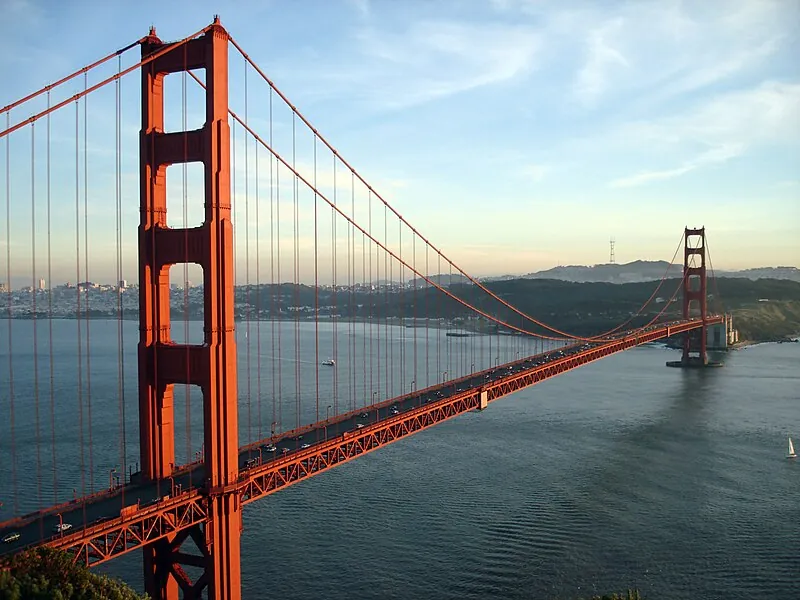
The Golden Gate Bridge — named not for gold but for the strait it spans (the "Golden Gate" strait was named by explorer John C. Frémont in 1846, before the Gold Rush) — is among the most recognisable engineering structures in human history. Its statistics are worth knowing: 2.7km total length; 227m towers rising from the strait; 1.2m main cable diameter (each cable composed of 27,572 individual galvanised steel wires); 600,000 rivets per tower. It took four years to build (1933–1937), employed 1,200 workers, and killed 11 men — a remarkably low fatality rate for a project of this scale in this era, due in part to the pioneering use of safety nets that saved 19 workers who fell during construction (they called themselves the "Halfway to Hell Club").
The best experiences of the Golden Gate: walking across it (the pedestrian path is open daily, 5am–9pm on the east side; the walk takes 30–40 minutes one way and provides vertigo-inducing views straight down into the churning strait); photographing it from Battery Spencer on the Marin Headlands (accessible via a 10-minute drive from the north end of the bridge — the view looking south over the bridge toward the San Francisco skyline is the classic shot); or watching it disappear and reappear as the fog rolls in from the Pacific.
The Fog: San Francisco's Most Distinctive Character
San Francisco's fog — locally named "Karl" by social media consensus — is not incidental to the city's character; it is fundamental to it. The fog forms when warm interior California air meets the cold Pacific upwelling (nutrient-rich water from the deep ocean that keeps surface temperatures in the bay well below what the latitude would suggest — San Francisco's average July high is only 18°C, far cooler than Los Angeles despite being 560km north). When warm air from the Central Valley rises, cold moist Pacific air rushes in through the Golden Gate gap in the Coast Range — the only gap — and spills over the hills as dramatic wave-like fog formations that billow down into neighbourhoods. Locals dress in layers year-round; the summer fog can make July feel more like October. This is not a disadvantage — it is the reason San Francisco's old Victorian houses survived (dry summers elsewhere in California create fire risk), and the reason the city's air quality is extraordinarily clean.
The Neighbourhoods
The Mission District
Originally a working-class Latino neighbourhood centred on the 1776 Mission Dolores (the oldest surviving building in San Francisco — the adobe walls of the original chapel predate the United States), the Mission has been in continuous tension between its Latino community and waves of gentrification since the first dot-com boom. What it offers visitors, with or without the socioeconomic guilt: some of San Francisco's most interesting street art (the 24th Street area has a density of murals — many political, many extraordinary — that rivals any outdoor gallery in the US), the city's best burritos (the Mission-style burrito — large, foil-wrapped, rice + beans + meat + guacamole in a flour tortilla — was developed here in the 1960s; La Taqueria and El Farolito are the great debates), and Valencia Street's concentration of bookshops, independent restaurants, and bars.
Haight-Ashbury
The intersection of Haight Street and Ashbury Street is the geographic symbol of the 1960s counterculture — the Summer of Love (1967), the Grateful Dead, Janis Joplin, and the Diggers (who gave free food in the Panhandle park). Today it is a tourist landmark, a neighbourhood of vintage shops, head shops, and the occasional older resident who actually was there. The legacy is more visible in the Panhandle and Golden Gate Park immediately adjacent — 412 hectares of park built from sand dunes from 1870 onward, containing the de Young Museum, the California Academy of Sciences (with its living roof and planetarium), and the Japanese Tea Garden (the oldest public Japanese garden in the United States, opened 1894).
The Castro
The Castro neighbourhood is the most historically significant LGBTQ+ district in the world — the community that elected Harvey Milk as the first openly gay elected official in California's history (to San Francisco Board of Supervisors, 1977), organised the first visible political response to the AIDS epidemic in the early 1980s, and has been the center of gay civil rights advocacy for five decades. The GLBT Historical Society Museum on 18th Street documents this history with precision and emotional power. The Castro Theatre (1922) is a magnificent Spanish Colonial Revival cinema still operating as an independent venue.
Alcatraz: The Island That Holds History
Alcatraz Island — 2.4km offshore in San Francisco Bay — was a federal penitentiary from 1934 to 1963, housing an average of 260 prisoners at any time (the most notorious inmates including Al Capone, George "Machine Gun" Kelly, and Robert Stroud, the "Birdman of Alcatraz"). Its location — in the coldest, most current-swept part of the bay — was chosen specifically for its escape deterrence; only 14 escape attempts were ever made, and no escapee was conclusively proven to have made it to the mainland (three men who disappeared in a 1962 escape — the Anglin brothers and Frank Morris — were never found and are presumed drowned, though a 2014 letter purportedly from John Anglin remains contested). The island is now a National Park Service site, with daily ferry service from Pier 33. The audio tour (narrated by former inmates and guards) is one of the best audio guides anywhere in the US.
The Food: America's Most Pioneering Food City
San Francisco's claim to being the most important food city in the United States is strong. The city pioneered the American farm-to-table movement (Chez Panisse in Berkeley, Alice Waters, 1971 — the restaurant that changed American cooking); it has the highest concentration of Michelin-starred restaurants per capita of any US city; and its geography — proximity to California's Central Valley (the world's most productive agricultural region), the Pacific Ocean (Dungeness crab, Pacific oysters, salmon, halibut), and the diversity of its immigrant communities — means the raw material of the food scene is extraordinary.
- Sourdough bread: San Francisco's sourdough is famous for a reason — the local Lactobacillus sanfranciscensis strain present in the bay's wild yeast environment produces a distinctive tangy acidity not replicable elsewhere. Boudin Bakery (est. 1849) has been maintaining its mother starter continuously since the Gold Rush.
- Ferry Building Marketplace: The 1898 Ferry Building on the Embarcadero, restored in 2003, houses one of America's great food markets — Tuesday and Saturday farmers' markets (California produce, artisan cheese, oysters, charcuterie) surround a permanent indoor market of exceptional food vendors.
Practical Information
- Getting there: San Francisco International Airport (SFO) or Oakland International (OAK — often cheaper, 30 minutes from SF by BART). BART (Bay Area Rapid Transit) connects SFO directly to downtown in 30 minutes.
- Getting around: MUNI (bus and historic streetcar) covers most areas; the cable cars are tourist experiences, not primarily transport, but the Powell-Hyde line is genuinely fun. Uber/Lyft are heavily used. Walking the hills is non-negotiable — San Francisco's hills are real (the steepest are over 30% grade).
- Best time: September–November — the city's warmest months (the "Indian summer"), when the fog retreats and temperatures reach 18–22°C. Avoid expecting warmth in July–August.
Related: Route 66: Driving America's Most Famous Road | Vancouver: Canada's Most Beautiful City