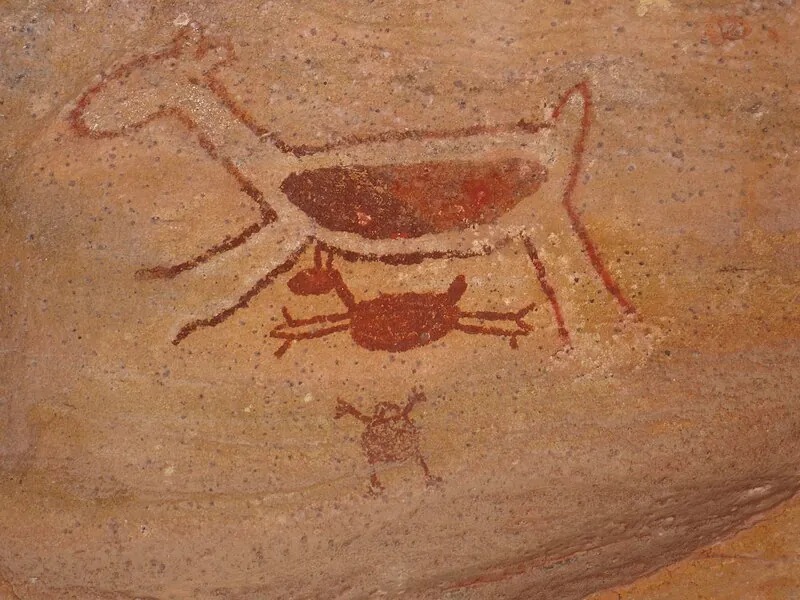
In the semi-arid backlands of Piauí state in northeast Brazil, a sandstone canyon system rising from the thorny caatinga scrubland contains something that overturns comfortable assumptions about the peopling of the Americas. The Serra da Capivara National Park — a UNESCO World Heritage Site since 1991 — holds over 1,354 archaeological sites and more than 30,000 individual prehistoric paintings: the densest concentration of rock art in the Americas, and among the most important in the world. Some of the charcoal found beneath these paintings has been dated to 25,000–50,000 years before the present — challenging the orthodox "Clovis First" theory that humans reached the Americas no earlier than 13,000 years ago. Whatever the eventual scientific consensus, the paintings themselves — vivid, energetic, surprisingly intimate in their depiction of human life — are one of the world's great experiences of direct connection with ancient humanity.
The Paintings: What the First Brazilians Left Behind
The Serra da Capivara paintings were made using mineral pigments — primarily ochre (iron oxide, producing reds and yellows), carbon (black), and manganese dioxide (dark red-brown) — applied to the sandstone walls of rock shelters and cliff faces. They depict:
- Hunting scenes: Groups of human figures pursuing animals, sometimes with spears or clubs clearly shown. The animals include the giant armadillo, giant anteater, wild pigs, and deer — several now extinct in the region.
- Social rituals: Scenes of communal dancing — groups of figures in chains or circles, some clearly in motion — are among the most dynamic and moving of the park's images
- Sexuality and reproduction: Explicit scenes of human sexuality, interpreted as fertility rituals — the frankness is remarkable given the age
- Combat: Groups of figures in apparent conflict, some with what appear to be projectile weapons
- Shamanic imagery: Figures in composite human-animal forms, interpreted as shamanic transformation rituals
The paintings span thousands of years of occupation — some sites contain images from multiple distinct periods, with different pigments and artistic styles superimposed in geological layers of human expression. The most recent may be 2,000 years old; the oldest potentially 25,000 or more. Walking among them is not simply a museum experience — it is a conversation across tens of millennia with humans who sat at these same rock faces and painted what they knew.
The Scientific Controversy: When Did Humans Arrive in the Americas?
The standard archaeological model — the "Clovis First" hypothesis — holds that humans crossed the Bering land bridge (Beringia) from Asia to North America approximately 13,000 years ago and spread south to reach South America by about 12,000–11,000 BP. The problem is that Serra da Capivara's charcoal deposits, found beneath layers of painting and in fire pits within the rock shelters, have been radiocarbon dated to 25,000–48,000 years BP by the French-Brazilian research team led by Dr. Niède Guidon, who has worked at the site since 1970.
The implications, if correct, would require a completely different model of human migration: humans in northeast Brazil 25,000–48,000 years ago could not have descended from a Beringian crossing — they would need to have arrived by a different route, most likely a Pacific coastal or transoceanic route from Southeast Asia or Australia. This directly connects to the Luzia skull discovered in the Lagoa Santa caves of Minas Gerais: a 10,000-year-old female skull with cranial morphology resembling modern Melanesian or Indigenous Australian populations rather than modern Native Americans, suggesting an earlier, distinct migration wave.
The mainstream archaeological community remains skeptical of the earliest dates — arguing that the carbon found in fire pits may have resulted from natural fires rather than human activity. The debate is genuine and unresolved. What is not disputed: Serra da Capivara was inhabited by humans for many thousands of years, producing art of extraordinary richness, in a location that should have been very difficult to reach under the standard models of American peopling.
The Key Sites Within the Park
Toca do Boqueirão da Pedra Furada
The most important and controversial site: a 70m-wide rock shelter with a spectacular waterfall cascade (seasonal) and the densest concentration of paintings in the park. The charcoal here produced the earliest dates. The panel of paintings on the walls — ochre figures dancing, hunting, interacting — is one of the most powerful single visual experiences in South American archaeology. The site's name means "The Hole of the Cave of the Pierced Rock," referencing the natural perforation in the rock face above.
Toca do Sítio do Meio
A site with one of the oldest confirmed human occupations — fossils of extinct megafauna (giant ground sloth, horse, camel) in the same archaeological layers as stone tools and charcoal, suggesting humans hunted or scavenged these animals. The extinction of South American megafauna coincides with human arrival in many scenarios.
Toca da Fumaça
An extensive painted site accessible by a more challenging trail through caatinga vegetation — rewarding for those willing to make the effort with exceptional quality of preserved paintings, fewer visitor footprints, and the experience of genuinely remote archaeological engagement.
The Caatinga: The Ecosystem Around the Park
The park is set within the caatinga — a biome unique to northeastern Brazil: a dry tropical forest of thorny, drought-adapted vegetation that goes leafless in the long dry season and bursts into green and flower immediately after the rains. The caatinga contains high levels of endemic species (animals and plants found nowhere else on Earth) and is one of the world's most threatened ecosystems, with significant conversion to agriculture. Within the park's 130,000 hectares, the caatinga is protected and hosts significant wildlife: maned wolf, giant anteater, giant armadillo, ocelot, and hundreds of bird species.
Practical Information
- Location: São Raimundo Nonato, Piauí state, northeast Brazil
- Getting there: Fly to Petrolina (Pernambuco) — 4-hour drive; or fly to Teresina — 5-hour drive. No direct flights to the nearest town.
- Best time: May–October (dry season). The rainy season (November–April) makes many trails impassable and the landscape less navigable, though dramatically green after the rains.
- Tours: Guided tours are required for most sites within the park — the trails are unmarked and the sites need interpretation. The Museum of the American Man (Museu do Homem Americano) in São Raimundo Nonato is an excellent pre-visit orientation.
- Physical demands: Most trails involve walking on uneven terrain in significant heat (35–42°C in dry season). Start early, carry water, wear sun protection.
- Accommodation: Limited but improving in São Raimundo Nonato; some visitor pousadas near the park entrance
Related: Northeast Brazil Beaches: Jericoacoara to Lençóis Maranhenses | The Amazon: Manaus and the River Jungle