Singapore is one of the world's most consistently impressive cities: immaculately maintained, architecturally audacious, safe, and built around a food culture that ranges from Michelin-starred hawker stalls selling chicken rice for SG$2 to restaurants charging SG$500 per person for a tasting menu. It is more expensive than its Southeast Asian neighbours, but far cheaper than equivalent experiences in London, New York, or Tokyo. Changi Airport has been repeatedly voted the world's best, the MRT runs to nearly everywhere you need to go, and the government's commitment to urban greening has transformed what was once a colonial port into one of the most liveable and genuinely beautiful cities in Asia. Even on a short layover, Singapore repays exploration.
Marina Bay and the Singapore Skyline
Marina Bay Sands
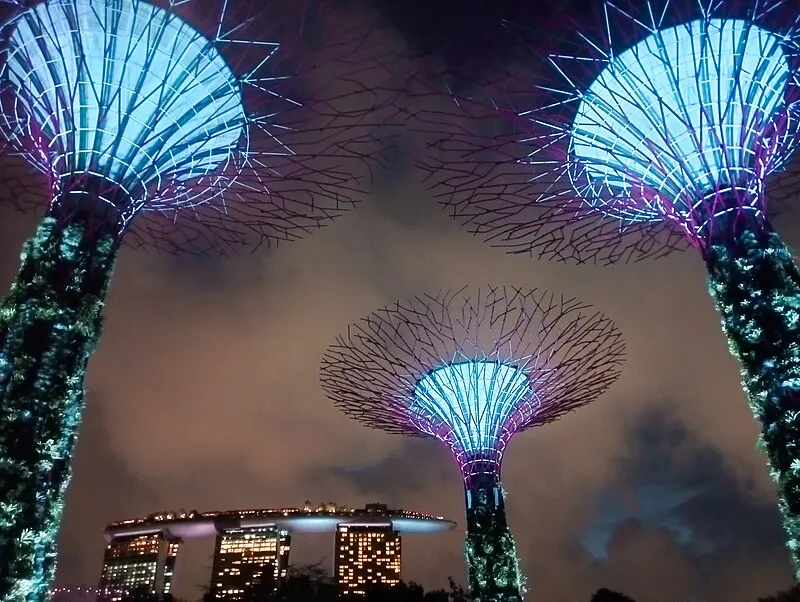
Marina Bay Sands (MBS) is the defining image of modern Singapore: three 55-storey towers connected by a 340-metre cantilever SkyPark containing a rooftop infinity pool, gardens, and observation deck. The SkyPark Observation Deck on the 57th floor is open to non-hotel guests for SG$32 (adults) and SG$23 (children). The pool itself is reserved for hotel guests only. The MBS hotel charges from around SG$500–800 per night for a standard room; pool access and the 360-degree view across the bay and city come with every stay.
The ArtScience Museum, housed in a lotus-shaped building at the base of MBS, hosts both permanent interactive science exhibitions and impressive travelling shows. The Shops at Marina Bay Sands is the most extravagant shopping mall in Singapore, with a canal running through its basement level and gondola rides available.
Gardens by the Bay
Gardens by the Bay sits adjacent to Marina Bay Sands on 101 hectares of reclaimed land. The outdoor Supertree Grove, where 18 tree-like vertical gardens stand 25–50 metres high, is free to walk through during the day; the OCBC Skyway, a walkway between the two largest Supertrees, costs SG$14 for adults. The free "Garden Rhapsody" light show at the Supertrees runs nightly at 19:45 and 20:45 and is one of the best free spectacles in Singapore.
The two climate-controlled domes are the ticketed highlights. The Flower Dome replicates a cool, dry Mediterranean climate with plants from five continents. The Cloud Forest Dome houses a 35-metre indoor mountain shrouded in mist with a waterfall, tropical plants, and walkways at multiple levels that descend through the cloud forest ecosystem. A combined ticket for both domes costs SG$28 for adults. These are extraordinary spaces and worth every cent on a hot Singapore afternoon.
Hawker Centres: Singapore's Greatest Food Institution
Singapore's hawker centres are open-air food courts where individual stalls specialise in single dishes, served at prices that have remained remarkably stable for decades. A full meal at a hawker centre costs SG$3–8 per dish. The UNESCO inscription of hawker culture in 2020 recognised the centres as living cultural heritage, and their ongoing relevance in a city of extraordinary restaurant wealth says much about the quality of the food served.
Newton Food Centre (Scotts Road) is the most tourist-frequented hawker centre and the one depicted in the film Crazy Rich Asians. Prices are slightly higher than local standards ($5–12 per dish) but the selection is excellent and it runs late. Recommended: the barbecued sambal stingray and the satay stalls.
Maxwell Food Centre (Chinatown) is where Tian Tian Hainanese Chicken Rice operates. Gordon Ramsay reportedly called it the best chicken rice he had ever eaten; it has a consistent queue. The chicken rice here (SG$5–6 per plate) is poached to extraordinary tenderness and served with fragrant rice cooked in chicken stock with ginger. Arrive before noon to avoid selling out.
Lau Pa Sat (Shenton Way, the financial district) is a Victorian-era market hall built in 1894 that operates as a hawker centre. It is best visited in the evening when satay stalls set up outside on Boon Tat Street and the surrounding financial district fills with office workers. The setting, inside a cast-iron clock tower building, is unlike any other hawker centre.
Singapore has three Michelin-starred hawker stalls as of 2024: Hill Street Tai Hwa Pork Noodle (Beach Road, one star, pork noodle soup at SG$6–8 per bowl), Hawker Chan (various outlets, one star, soya sauce chicken at SG$3–5), and Liao Fan Hong Kong Soya Sauce Chicken Rice and Noodle (Chinatown Complex, one star). A Michelin star and SG$6 per bowl in the same sentence is uniquely Singaporean.
Neighbourhoods Worth Exploring
Little India
Little India, centred on Serangoon Road, is one of Singapore's most vibrant and colour-saturated neighbourhoods. The Sri Veeramakaliamman Temple (built in 1881) is an active place of worship with extraordinary gopuram sculpture. The Tekka Centre market is the place to eat Indian food for breakfast: roti prata with dhal (SG$1.20–2 per piece) and teh tarik (pulled tea) is one of Singapore's great cheap meals. Little India is also the best neighbourhood for fresh flower garlands, spice shopping, and the Mustafa Centre, a 24-hour department store beloved by Singaporeans for its extraordinary breadth of goods.
Chinatown and the Baba-Nyonya Heritage
Singapore's Chinatown preserves some of the finest pre-war shophouse architecture in Southeast Asia. The Chinatown Heritage Centre documents the experience of early Chinese immigrants. The Sri Mariamman Temple, Singapore's oldest Hindu temple (1827), sits improbably in the middle of Chinatown. The Chinatown Complex food centre is one of the best for traditional Chinese dishes. The Baba-Nyonya (Peranakan) culture, a hybrid of Chinese and Malay traditions developed over centuries of intermarriage, is most visible in the Katong and Joo Chiat areas of eastern Singapore.
Kampong Glam
Kampong Glam, the Malay quarter, is centred on Arab Street and Haji Lane. The Sultan Mosque (1932), with its golden dome visible from surrounding streets, is the neighbourhood's anchor. Haji Lane is a narrow alley lined with independent boutiques, vintage shops, and cafes that has become one of the most photographed streets in Singapore. The neighbourhood has excellent Middle Eastern and Malay restaurants, and the Zam Zam restaurant (established 1908) still serves murtabak and biryani to long queues of regulars.
Sentosa Island
Sentosa, connected to the mainland by a causeway, cable car, and MRT, is Singapore's leisure island. Universal Studios Singapore is its main attraction, with seven themed zones including the world's first Battlestar Galactica duelling coasters and a Puss in Boots ride. Admission costs SG$83 for adults (2024). The island also has beach clubs along Siloso, Palawan, and Tanjong beaches, the SEA Aquarium, Adventure Cove Waterpark, and the Sentosa Golf Club (where the Serapong course hosted the HSBC Champions event). Resorts World Sentosa includes several luxury hotels as well as the Marine Life Park, the largest aquarium in Southeast Asia by water volume.
Changi Airport: Worth Visiting Even Without a Flight
Changi Airport, consistently ranked the world's best airport by Skytrax for multiple consecutive years, has an attraction that draws visitors who have no travel plans at all. The Jewel Changi Airport, opened in 2019, is a 10-storey glass-and-steel dome containing the HSBC Rain Vortex, the world's tallest indoor waterfall at 40 metres. The surrounding Shiseido Forest Valley, with 2,000 trees and 100,000 shrubs across five storeys, can be visited free of charge. Light and sound shows run nightly at the waterfall. Dozens of restaurants and shops fill the remaining levels. Entry to Jewel is free; some attractions within it (the Canopy Park at the top floor, SG$10–14) charge separately.
Practical Information
Getting around: The MRT is the best way to travel in Singapore. A journey from Changi Airport to the city centre costs around SG$2.00–2.50 on the EZ-Link stored-value card (purchasable at any MRT station for SG$10 including SG$7 stored value). Taxis and Grab (the dominant rideshare app in Southeast Asia) are widely available and relatively affordable by Western standards: a cross-city trip typically costs SG$12–20.
Visa: Citizens of the UK, US, EU, Australia, Canada, and most Western nations can visit Singapore visa-free for up to 30 or 90 days depending on nationality. Transit visitors (48-hour or 96-hour Free Transit Pass) can enter the city from Changi Airport without a visa and return for their connecting flight.
Budget: Singapore is the most expensive country in Southeast Asia and comparable to Western European capitals. A mid-range budget (decent hotel, hawker meals with one restaurant meal per day, attractions) runs around SG$200–300 per day (approximately £120–180 or $150–220). Budget travellers using hostels and eating exclusively at hawker centres can manage around SG$80–120 per day.
Weather: Singapore sits 1.4 degrees north of the equator: it is hot and humid year-round (28–33°C). Rain is possible in any month; the wettest months are November to January during the northeast monsoon. Carry a lightweight rain jacket and embrace the air-conditioning that makes almost every indoor space pleasantly cool.
Related: Bangkok Travel Guide: Temples, Street Food, and Rooftop Bars | Bali Travel Guide: The Best of Indonesia's Island of Gods