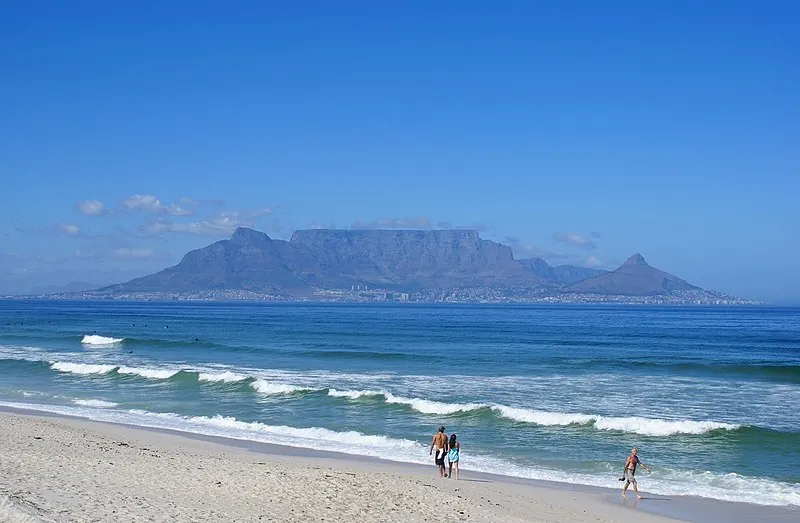
South Africa packs more variety into a single country than almost anywhere else on earth. Within roughly 1.2 million square kilometers you can watch a leopard hunt at dawn in the Lowveld, drink a world-class Chenin Blanc in the Winelands, drive a coastal road that competes with Big Sur, and stand at the point where two oceans meet. For international visitors the rand's long-term weakness against major currencies makes the country extraordinarily good value: a Big Five safari that costs $800 per night at an equivalent lodge in Botswana or Tanzania runs $200 to $350 in the Kruger ecosystem. This guide covers the four main pillars of a South Africa trip and the safety information every traveler needs.
Cape Town
Table Mountain
Table Mountain is non-negotiable. The cable car (R390 adults, roughly $21 at 2024 exchange rates) runs from the lower station at Tafelberg Road to the 1,086-meter summit when weather permits. Check the Cape Town Tourism website or the official app the morning of your visit; the mountain generates its own cloud cover ("the tablecloth") that closes the cable car with little notice. The hike via Platteklip Gorge takes about two hours and is accessible for fit walkers, but go with a guide or a group; the mountain has a history of muggings on less-trafficked paths.
Neighborhoods and Beaches
The V&A Waterfront is the tourist hub, reliable and walkable, with the Two Oceans Aquarium (R225) and dozens of restaurants. For local character, head to the Bo-Kaap (the Cape Malay quarter with its pastel-painted houses), the Old Biscuit Mill market in Woodstock (open Saturdays 09:00 to 14:00), and the Long Street bar district. Camps Bay beach, 10 km from the city center, offers white sand with Table Mountain as a backdrop; the water temperature averages 14°C because of the Benguela current, so come for the scenery rather than swimming. Muizenberg on the False Bay side (water averages 20°C) is the city's surf beach and the most accessible for beginners.
Day Trips from Cape Town
Cape Point and the Cape of Good Hope, the southwestern tip of the African continent, sit within the Table Mountain National Park (R363 entry). Combine with a stop at the Boulder's Beach penguin colony near Simon's Town, where around 3,000 African penguins can be observed from boardwalks (R185). The full Cape Peninsula drive covers about 150 km and takes a full day. Chapman's Peak Drive, a privately maintained toll road (R55), is one of the most dramatic coastal routes in the world.
The Garden Route
The N2 highway between Mossel Bay and Storms River covers roughly 300 km of coastline, forest, and lagoon that together form the Garden Route. Most visitors drive the route over three to five days, stopping at George (the main airport for the region, with flights from Cape Town on FlySafair for R400 to R800), Knysna, Plettenberg Bay, and Tsitsikamma National Park.
Knysna's Heads, a pair of sandstone cliffs guarding the lagoon entrance, are the region's most photographed landmark. The Knysna Oyster Festival in July draws 80,000 visitors. Storms River Mouth inside Tsitsikamma National Park offers bungee jumping from the 216-meter-high Bloukrans Bridge (the highest commercial bungee in the world, R1,295), hiking the Otter Trail (a five-day, 42.5-km route that requires booking up to a year ahead), and snorkeling in the reserve's marine protected area.
Accommodation along the Garden Route ranges from R350-per-night backpacker lodges to R4,000-per-night boutique hotels in Plettenberg Bay. The Fairy Knowe Backpackers in Wilderness is a reliable mid-budget base at around R550 per person.
Kruger National Park and the Surrounding Private Reserves
Kruger covers 19,485 square kilometers, roughly the size of Wales or Israel, and contains the highest density of Big Five wildlife (lion, leopard, elephant, rhino, and buffalo) of any national park in Africa. Self-drive access through the SANParks gate system costs R372 per person per day for international visitors. The park has 21 rest camps with accommodation ranging from basic camping (R235 per site) to fully equipped safari tents and chalets (R1,200 to R3,500). Book via SANParks.org, which opens reservations 11 months in advance; peak season (June to September, the dry winter) fills up quickly.
The private reserves bordering Kruger's western boundary, including Sabi Sand, Timbavati, and Klaserie, offer walking safaris and night drives not permitted in the national park itself. Lodge rates here start at R3,500 per person per night (full board and two game drives daily) and reach R35,000 per person per night at ultra-luxury properties like Singita Boulders. The value proposition lies in the exclusivity and the guide-to-guest ratios: private lodges typically work with one ranger and one tracker per vehicle of six guests, dramatically increasing sighting rates for elusive species like leopard and wild dog.
Hoedspruit or Nelspruit (Kruger Mpumalanga International Airport) are the closest airports, with multiple daily connections to Johannesburg's OR Tambo International. Fly-in packages simplify logistics considerably.
Stellenbosch and the Winelands
The Cape Winelands lie 45 km east of Cape Town via the N2 and N1, and a full day or overnight stay in Stellenbosch, Franschhoek, or Paarl makes a natural addition to any Cape Town trip. South Africa's wine industry produces 1.1 billion liters annually (making it the world's seventh-largest producer in 2023 figures from the South African Wine Industry Statistics report), with Stellenbosch Chenin Blanc, Franschhoek Chardonnay, and Swartland Syrah among the most internationally acclaimed styles.
Wine tasting fees range from R50 to R200 per estate, usually redeemable against purchases. Boschendal (established 1685) offers one of the most complete visitor experiences, with a farm-to-table restaurant and picnic lunches among the vineyards. Delaire Graff, owned by diamond dealer Laurence Graff, has the valley's most spectacular setting and a tasting menu priced at R695 per person. For sheer value, Kleine Zalze's Restaurant Terroir serves a three-course lunch with wine pairing for around R550.
Franschhoek, a 30-minute drive from Stellenbosch, has the highest concentration of acclaimed restaurants per capita of any town in South Africa. The Franschhoek Motor Museum (R200) houses one of the world's most impressive private car collections.
Safety in South Africa
South Africa has a high rate of violent crime concentrated in specific areas. The U.S. State Department, UK Foreign Office, and Australian DFAT all advise increased caution. The practical rules for tourists are consistent across sources:
- Do not walk in unfamiliar areas after dark. Use Uber or a trusted taxi service.
- Keep car doors locked and windows up in cities, particularly at traffic lights (robots).
- Do not display expensive cameras, jewelry, or phones on the street.
- Use ATMs inside shopping malls or bank branches rather than on the street.
- The tourist areas of Cape Town (V&A Waterfront, Camps Bay, the City Bowl during daylight), Stellenbosch, and the Garden Route towns are generally safe with normal precautions. The Cape Flats, parts of Johannesburg's inner city, and certain areas near Durban require specific local knowledge.
- Townships (informal settlements) should be visited only with a reputable tour operator who employs community guides.
Comprehensive travel insurance that covers medical evacuation is essential. Medical facilities in Cape Town and Johannesburg are high quality at private hospitals; rural areas are a different matter.
Practical Information
- Currency: South African rand (ZAR). R1 = approximately $0.054 in mid-2024.
- Visa: Citizens of the UK, EU, USA, Canada, and Australia receive 90 days visa-free.
- Best time: May to September (dry winter) for Kruger wildlife viewing. November to February (summer) for Cape Town beaches. The Garden Route is accessible year-round.
- Driving: South Africa drives on the left. Car hire from Cape Town Airport starts at R400 per day for a small vehicle. A 4x4 is not required for Kruger's main roads.
- Health: Malaria prophylaxis is recommended for the Kruger/Lowveld region. No malaria risk in Cape Town or Stellenbosch.
Related: Kenya Safari Guide: Maasai Mara and Beyond | Responsible Wildlife Tourism: How to Visit Africa Ethically