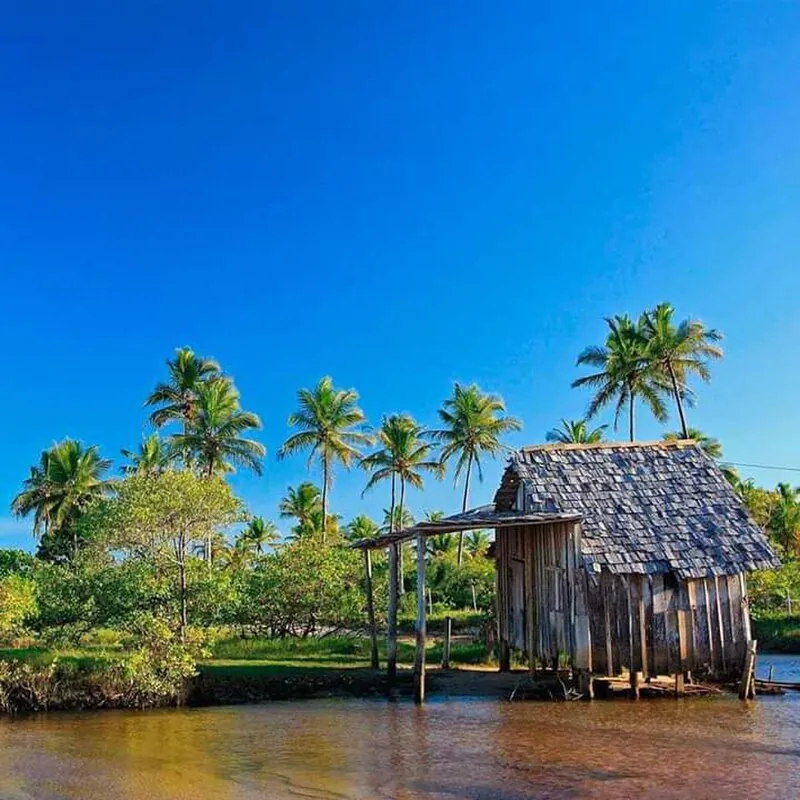
In 1970, Trancoso was a village of approximately 300 people — descendants of Pataxó Indigenous families and Afro-Brazilian fishing communities — in one of the most isolated parts of southern Bahia. The historic center, the quadrado, was a grass-covered square surrounded by dilapidated colonial houses that had stood since the Portuguese founded the settlement in the 16th century. There was no road connecting it to the rest of Brazil. The world — particularly the Brazil of economic growth and urbanisation that was consuming the rest of the country — had simply not arrived. In the early 1970s, artists and alternative travellers from Rio and São Paulo began appearing. They came by boat, along the coast, or on foot through the Atlantic Forest. They stayed. Some built simple houses. The secret held for about twenty years.
By the 1990s, the Brazilian elite had found it. By the 2000s, the international celebrities and fashion world followed. Today, Trancoso — 47km south of Porto Seguro in the state of Bahia — is arguably the most fashionable small beach destination in South America, the place where Brazilian musicians, architects, actors, and industrialists build their second homes and where international visitors pay serious money for the privilege of a week in a rented villa with a pool in the Atlantic Forest. And yet the village itself — the quadrado, the beaches, the cooking — remains genuinely beautiful. The secret kept itself, because the village had something that money cannot easily destroy: a physical structure — the cliffs, the position, the church, the proportions of the square — that resists the architecture of resort development. You cannot build high-rises on a grassy medieval square.
The Quadrado: The Heart of Everything
The quadrado (literally: square) is the defining experience of Trancoso — a 300m-long grass rectangle bordered on three sides by the brightly painted 16th–18th-century colonial houses that Brazilians call casas na quadrado, and on the fourth by the white-washed Igreja de São João Batista — one of the oldest churches in Brazil, built around 1586 by Jesuit missionaries, simple to the point of austerity, its single tower looking out over the square toward the Atlantic.
The colonial houses that line the square have been converted, almost entirely, into restaurants, boutiques, art galleries, and pousadas — but the conversion has been done with unusual restraint. No neon signage. No chain stores. No concrete additions. The houses retain their original scale, their painted wooden doors, their terracotta roofs. The grass of the square is kept but not fussed over. It has the character of a village that has been preserved not by official heritage policy but by the aesthetic consensus of the people who chose to invest in it — people who were, before they were wealthy, attracted by beauty, and who understood that destroying the beauty would destroy the reason for being there.
The quadrado at night — string lights in the trees, the smell of moqueca and grilled fish, the occasional sound of live music from one of the bars — is one of the most pleasant public spaces in South America.
The Beaches: Spectacular and Varied
The cliffs behind the quadrado drop to a wide beach below — a 15-minute walk via wooden steps and paths through the Atlantic Forest. The main beach at Trancoso is backed by the same forest-covered cliffs that give the quadrado its elevated position, creating a visual drama — the green cliff face, the white sand, the Atlantic — that makes it one of the more architecturally significant beaches in Brazil. But the most spectacular beaches require some distance:
Praia do Espelho (Mirror Beach)
Eighteen kilometres south of Trancoso — accessible by 4WD track through Atlantic Forest, or by boat — Praia do Espelho is one of Brazil's genuinely extraordinary beaches. The name comes from the behaviour of the tide: at low tide, the coral reef platforms that extend from the base of the red sandstone cliffs fill with water that perfectly reflects the sky above — "mirror pools" 100–300m wide, shallow enough to walk through, warm, crystal clear, and filled with the coral and marine life of the Abrolhos bank. The cliffs themselves are multi-coloured — the iron-rich red sandstone layered with yellow and orange bands, shaped by erosion into arches and columns. The beach is backed by Atlantic Forest. There are two restaurants, no hotels, no paved road. It is, by any measure, one of the most beautiful beach environments in South America.
Praia dos Nativos
Immediately south of the Trancoso village cliffs, the long arc of Praia dos Nativos stretches with minimal development — a wide beach of pale sand, with the forest behind and the reef-calmed water in front. The beach is the domain of local families, the horses that are still used for transport in the rural areas of southern Bahia, and the occasional fisherman hauling in nets. The contrast with the sophistication of the quadrado above is one of Trancoso's fundamental tensions — and one of its most honest qualities.
The Food: Bahian Tradition Meets Contemporary Ambition
Bahian cooking — rooted in the African traditions brought by enslaved people who arrived in Brazil's largest slave port, Salvador, between the 16th and 19th centuries — is among the most distinctive regional cuisines in South America. The foundational ingredients: dendê oil (West African palm oil, reddish-orange, with a specific flavour that characterises Bahian cooking more than any other single ingredient), coconut milk, fresh chillies, ginger, dried shrimp, and the rich Gulf fish and crustaceans of the Bahian coast. The classic dishes available throughout Trancoso's restaurants:
- Moqueca baiana: A seafood stew — fish, shrimp, or a mix — cooked in dendê oil and coconut milk with tomatoes, onions, and coriander in a clay pot. The Bahian version (as distinct from the capixaba version of Espírito Santo, which uses no dendê) has a rich, aromatic depth and a brilliant orange colour from the palm oil.
- Acarajé: Black-eyed pea fritters fried in dendê oil by the baianas de acarajé — women in traditional white lace dress who sell them from street stalls. The fritter is split and filled with vatapá (a paste of bread, dried shrimp, coconut milk, and peanuts), caruru (okra in dendê), and fresh tomato salsa. An Afro-Brazilian food culture UNESCO-listed as Intangible Cultural Heritage.
- Contemporary Bahian: Several of Trancoso's restaurants have taken the traditional ingredients and applied contemporary technique — the result is some of the most interesting cooking in Brazil, combining the depth of Bahian tradition with the ambition of the São Paulo fine dining scene.
The Pataxó People: The Original Inhabitants
The region around Trancoso and Porto Seguro is the traditional territory of the Pataxó people — one of the few Indigenous nations of Bahia who survived the colonial period with their community intact. The nearby village of Aldeia Velha (16km from Trancoso) is a Pataxó community that receives visitors and sells traditional crafts, seeds, and food products. The relationship between the Pataxó and the tourism economy of southern Bahia is complex — the land disputes around the Monte Pascoal National Park (the site of Cabral's first sighting of Brazil in 1500, reclaimed by the Pataxó in 1999) remain unresolved — but the community's cultural vitality and the quality of their traditional knowledge (particularly botanical knowledge of the Atlantic Forest) make an engagement with their community one of the most genuinely educational experiences available in the region.
Practical Information
- Getting there: Fly to Porto Seguro (BPS) — direct flights from São Paulo and Rio de Janeiro. From Porto Seguro: 47km south by taxi or transfer (1 hour via ferry crossing the river then road). Private transfers bookable from Porto Seguro Airport.
- Getting around: On foot within the village; taxi and 4WD for beaches and surrounding areas. Praia do Espelho requires a 4WD or boat.
- Best time: May–September (dry season, warm, less crowded). December–February is peak Brazilian summer — warm, lively, but expensive and busy. Trancoso at New Year is famous for its parties and correspondingly crowded and expensive.
- Where to stay: Pousadas on or near the quadrado for atmosphere; private villa rental (through local agencies or international platforms) for privacy and pools. The internationally known UXUA Casa Hotel & Spa — a restored fisherman's house development on the quadrado — is the most beautiful hotel in Bahia by most assessments.
Related: Northeast Brazil Beaches: Jericoacoara and Lençóis Maranhenses | Rio de Janeiro: The Marvelous City