Every city claims to be unlike any other. New York City actually is. It is not the world's most beautiful city — there are more aesthetically consistent places. It is not the most historically layered — European capitals have millennia of accumulated architecture that Manhattan's 400-year history cannot match. It is not the most relaxed — it is the opposite. But New York is the city where the full spectrum of human possibility — at every economic level, from every culture and country, in every art form, cuisine, and subcultural expression — exists simultaneously, at density, in collision, producing the creative friction that has made it the cultural capital of the 20th century and the aspirational center of global ambition for everyone who wants to be somewhere where their talent might be recognised and rewarded. The cliché that "if you can make it there, you can make it anywhere" is a cliché because it is accurate. And as a visitor, you feel this energy immediately — on the first subway ride, in the first morning walk down a midtown street, in the first meal anywhere from a Midtown deli to a Brooklyn tasting menu. New York is the most alive city in the world. Understanding how to navigate it is simply a matter of knowing where to look.
Manhattan: The Neighbourhoods That Matter
Lower Manhattan and Financial District
The southern tip of Manhattan — where the Dutch colony of New Amsterdam was founded in 1626 — contains the city's oldest surviving street grid and two of its most significant memorials:
- 9/11 Memorial and Museum: The twin reflecting pools occupying the footprints of the original World Trade Center towers, surrounded by the names of the 2,977 victims. The underground museum — opened 2014 — is one of the most powerful memorial museums in the world. Allow 2–3 hours.
- Staten Island Ferry: Free. 25-minute crossing from Whitehall Terminal to Staten Island and back, passing directly beside the Statue of Liberty (closer than the paid tour boats). The best free view in New York.
- Brooklyn Bridge: The 1883 Gothic Revival suspension bridge — at the time of its completion the world's largest suspension bridge, an engineering marvel that killed 27 workers during construction — has a pedestrian walkway above the traffic lanes. The walk from Manhattan to Brooklyn (20 minutes) provides the definitive Manhattan skyline photograph.
Midtown: Skyscrapers and Spectacle
Midtown Manhattan — roughly 34th to 59th Street — is where the New York of the popular imagination actually exists: the Empire State Building, Times Square, Rockefeller Center, the Museum of Modern Art, Central Park's south end, the Chrysler Building. Most of it is extremely tourist-dense, but the specific experiences within it are genuinely worth having:
- Top of the Rock (Rockefeller Center): The observation deck of 30 Rockefeller Plaza at 260m offers the definitive Manhattan panorama — including the Empire State Building, which you cannot see from the Empire State Building. The view at sunset is extraordinary.
- The High Line: An elevated freight railway converted into a 2.3km linear park above the West Side, from Gansevoort Street in the Meatpacking District to 34th Street — one of the most successful urban infrastructure transformations in recent urban history. The park opened in 2009 and has been credited with generating over $2 billion in adjacent real estate development. Walk it in the morning before the crowds.
- Grand Central Terminal (1913): Not merely a transit hub but one of the greatest civic spaces in the world — the Beaux-Arts main concourse with its celestial ceiling, the light shafts, the whispering gallery, the Oyster Bar restaurant (serving since 1913).
Central Park: 341 Hectares of Designed Nature
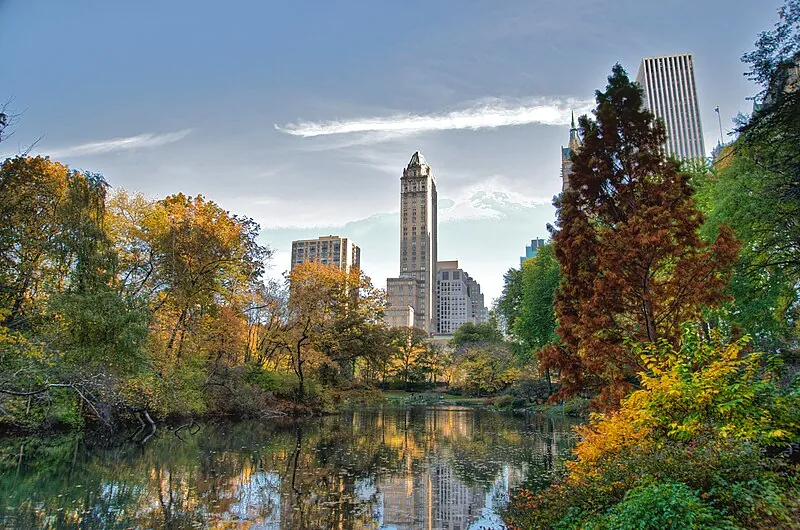
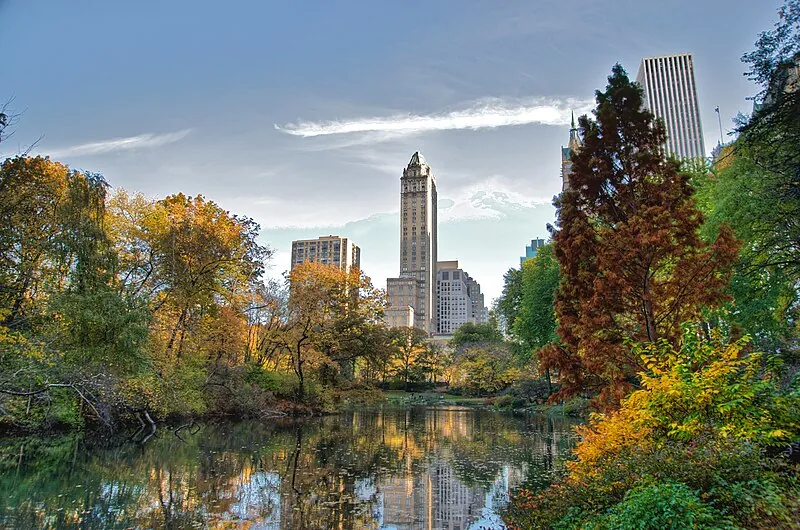
Central Park — designed by Frederick Law Olmsted and Calvert Vaux, construction beginning 1858 on land cleared of its 1,600 impoverished residents — is one of the greatest works of landscape design in history. The park is 4km long by 0.8km wide, entirely manmade (the "natural" landscape of rocky outcrops, ponds, and meadows was engineered from a swamp and wasteland), and receives approximately 40 million visits per year. Key experiences:
- The Ramble — the deliberately naturalistic woodland section in the middle of the park, where the original planned landscape most successfully disappears into something resembling genuine wilderness within a city block of midtown Manhattan
- Bethesda Fountain and Terrace — the Victorian formal architecture at the heart of the park, the setting for countless films
- Strawberry Fields — the memorial to John Lennon, who was shot outside the Dakota building directly across the street in December 1980
- The Metropolitan Museum of Art on the park's east edge — the largest art museum in the Western Hemisphere, requiring multiple visits to begin to understand its collection
Brooklyn: The Borough That Changed the World
Brooklyn — formerly an independent city (the fourth largest in the US before its 1898 merger with Manhattan), now the most densely populated borough — has been the incubator of American cultural production for most of the past 30 years. The neighbourhoods to know:
- DUMBO (Down Under the Manhattan Bridge Overpass): The waterfront neighbourhood with the most photogenic view of the Manhattan Bridge and Brooklyn Bridge combined — the cobblestone streets, the art galleries, the Jane's Carousel in its glass pavilion, the direct Manhattan skyline view from Brooklyn Bridge Park.
- Williamsburg: The neighbourhood that defined the early 2000s American creative class — warehouses converted to studios, independent music venues, food halls (the Smorgasburg outdoor food market on Saturdays), and a restaurant scene that has been influential nationally and internationally.
- Prospect Park: Olmsted and Vaux's other great New York park — designed after Central Park, with some arguing it is the superior work. The Prospect Park Zoo, the boathouse, and the summer concerts at the bandshell are the main draws.
The Food: Every Cuisine at Every Price
New York's claim to being the world's best food city rests on a simple fact: the concentrated wealth, the enormous immigrant communities maintaining genuine culinary traditions, and the competitive intensity of the restaurant market produce a density of excellent eating at every price point that no other city matches. A selective guide:
- Pizza: New York pizza is its own category — the large, fold-in-half thin-crust slice made in coal or gas deck ovens, eaten standing at a counter. Di Fara Pizza (Brooklyn, Midwood) — Dom DeMarco made every pizza himself for 50 years, still the gold standard. Joe's Pizza (Greenwich Village) — the affordable everyday benchmark. Lucali (Brooklyn, Carroll Gardens) — reservation-required, three-hour wait, the most sought-after slice in the city.
- Bagels: New York bagels are different from bagels elsewhere — boiled before baking (which creates the distinctive chew), made with New York tap water (the mineral content of which is genuinely argued to affect the dough). Ess-a-Bagel, H&H Bagels, and Russ & Daughters (the 1914 appetising shop on Houston Street — smoked salmon, sturgeon, caviar, and cream cheese) are the canonical institutions.
- The deli: New York's Jewish delicatessen tradition — corned beef, pastrami, brisket, matzo ball soup, knishes — is one of the most underappreciated in American food culture. Katz's Delicatessen (Lower East Side, opened 1888) is the most famous and genuinely excellent — the pastrami on rye is arguably the best sandwich in the city.
- Chinatown: Manhattan's Chinatown (Canal Street area) and the much larger Flushing Chinatown (Queens) offer the best Chinese food in the Western Hemisphere — the Flushing food courts have regional Chinese cooking of a quality and variety unmatched outside China itself.
Practical Information
- Getting there: JFK International (international and domestic), LaGuardia (primarily domestic), Newark (New Jersey — often cheaper, 30–45 minutes to Manhattan by train/bus). From JFK, take the AirTrain to Jamaica Station, then the Long Island Rail Road or Subway E/J/Z train to Manhattan.
- Getting around: Subway — get an OMNY card (tap-to-pay contactless), unlimited 7-day pass available. Walking in lower/mid Manhattan. Uber/Lyft supplement but the subway is faster for most routes.
- Budget: Hotel costs are the primary variable — Manhattan hotels: $150–$500+/night; Brooklyn often $30–$40 cheaper per night. Food can be done on $30/day or $300/day, both legitimately. Museum suggested donations (the Met, MOMA, the Museum of Natural History) allow entry at any price; the Whitney, Guggenheim, and Frick have fixed admission.
- Best time: September–November (autumn colour in Central Park, comfortable temperatures, New York Film Festival, less humidity than summer). Spring (April–May) is also excellent. Avoid late July–August (hot, humid, tourist-dense).
Related: San Francisco: The City That Keeps Reinventing Itself | Tokyo: The World's Most Extraordinary City